





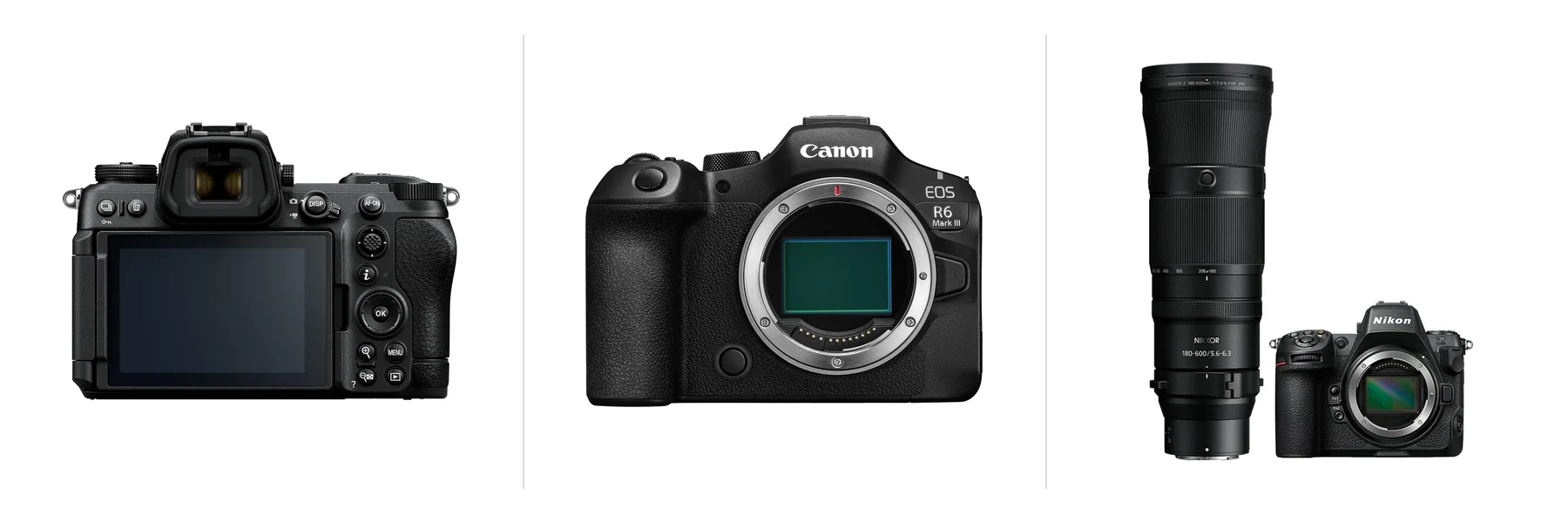
In the 2026 mirrorless market, the Nikon Z6 III, Canon EOS R6 Mark III, and Nikon Z8 offer distinct approaches to hybrid photography and videography. The Z6 III emphasizes accessible high-speed performance and video tools, the R6 Mark III focuses on class-leading autofocus and burst rates, while the Z8 delivers flagship image quality and 8K recording. This comparison uses our published review data to highlight real-world differences in performance, ergonomics, and value.
At a Glance
| Feature | Nikon Z6 III | Canon EOS R6 Mark III | Nikon Z8 |
|---|---|---|---|
| Price | $1996.95 | $2799.0 | $5246.95 |
| Overall Score | 90/100 | 89/100 | 89/100 |
| Best For | Sports, wildlife & hybrid creators | Professional AF-driven hybrid work | Pro 8K video & maximum image quality |
| Burst Shooting | 20fps blackout-free with reliable tracking | 40fps electronic with deep buffer | High-speed with minor EVF limitations |
| Video Capabilities | 6K/60p RAW with monitoring tools | 6K RAW with comprehensive tools | 8K/60p with excellent heat management |
| Autofocus | Reliable subject tracking | Revolutionary AI autofocus | Lightning-fast with reliable detection |
Design and Build
All three cameras deliver professional-grade build quality with weather sealing suitable for demanding conditions. The Nikon Z6 III stands out with exceptional build quality, improved ergonomics, and a class-leading electronic viewfinder, while the Canon EOS R6 Mark III offers outstanding ergonomics and weather-sealed construction designed for harsh environments. The Nikon Z8 matches this robustness with comprehensive weather sealing, comfortable ergonomics, and intuitive controls that reduce fatigue during extended shoots.
Common usability challenges exist across the trio. Menu systems on all models retain notable depth that can overwhelm newcomers, though each has seen improvements. The Nikon Z8’s electronic viewfinder can exhibit minor blackout or lag during the most extreme burst rates, and both the Canon EOS R6 Mark III and Nikon Z8 lack built-in GPS, requiring smartphone connections for location data. For deeper analysis, see our full review of Nikon Z6 III, full review of Canon EOS R6 Mark III, and full review of Nikon Z8.
Performance and Features
The Nikon Z6 III excels at blazing 20fps blackout-free shooting with reliable subject tracking that performs exceptionally well in sports and wildlife photography. It pairs beautiful Nikon color science with excellent dynamic range and high-ISO performance, plus outstanding 6K/60p RAW video capabilities complete with comprehensive monitoring tools. However, 6K recording can trigger overheating warnings after approximately 25-35 minutes in warm conditions, and it lacks a pixel-shift high-resolution mode.
The Canon EOS R6 Mark III raises the speed bar with blazing 40fps electronic shutter performance that offers virtually no blackout and a deep buffer. Its revolutionary AI autofocus tracks complex subjects with remarkable consistency, making it a standout for demanding action. Professional-grade 6K RAW video recording with comprehensive monitoring tools rounds out its hybrid credentials, though battery life drops significantly during 6K capture.
The Nikon Z8 differentiates itself with true 8K/60p video recording and excellent heat management for its class, alongside exceptional image quality featuring class-leading dynamic range and detail. Lightning-fast autofocus with reliable subject detection works consistently across scenarios. All three cameras offer versatile hybrid stills/video control layouts, though the Z8 and Canon model require extra battery planning for full-day high-intensity use.
Pricing and Value
Priced at $1996.95, the Nikon Z6 III delivers the strongest value in this group with its 90/100 overall score. It provides blazing speed, excellent video tools, and pro-level ergonomics at a significantly lower cost than its rivals, making the premium over the previous generation easier to justify for enthusiasts and hybrid creators.
At $2799.0, the Canon EOS R6 Mark III represents a serious investment that may feel excessive for hobbyists, though its revolutionary AI autofocus and 40fps performance justify the outlay for professionals. The Nikon Z8 at $5246.95 sits firmly in flagship territory; while its 8K capabilities and superior image quality are class-leading, the high price positions it beyond most enthusiast budgets and only for those who truly need its specific advantages.
Pros and Cons
Nikon Z6 III
Pros:
– Blazing 20fps blackout-free shooting with reliable subject tracking that excels in sports and wildlife photography.
– Outstanding 6K/60p RAW video capabilities with comprehensive monitoring tools for serious hybrid creators.
– Exceptional build quality with improved ergonomics and a class-leading electronic viewfinder.
– Beautiful Nikon color science paired with excellent dynamic range and high-ISO performance.
– Versatile dual card slots and thoughtful hybrid stills/video control layout.
Cons:
– The 24.5MP resolution may disappoint landscape and commercial photographers who need higher detail for large prints or heavy cropping.
– Menu system, while improved, remains more convoluted than Sony’s latest interface and has a learning curve for newcomers.
– Video recording in 6K mode can still trigger overheating warnings after approximately 25-35 minutes in warm conditions.
– Premium price represents a significant jump from the Z6 II, potentially pricing out some enthusiasts.
– No pixel-shift high-resolution mode, unlike several competitors in this price range.
Canon EOS R6 Mark III
Pros:
– Blazing 40fps electronic shutter with virtually no blackout and deep buffer.
– Revolutionary AI autofocus that tracks complex subjects with remarkable consistency.
– Professional-grade 6K RAW video recording with comprehensive monitoring tools.
– Outstanding ergonomics and weather-sealed build quality suitable for harsh conditions.
– Excellent battery life for a camera with this level of processing power.
Cons:
– Resolution remains at 24.2MP, which may disappoint users needing more detail for large prints or heavy cropping.
– Battery life drops significantly when shooting 6K video, requiring frequent spares for all-day shoots.
– The learning curve for the extensive menu system and customization options can be steep for newcomers.
– Price positions it as a serious investment that may be excessive for hobbyists.
– No built-in GPS, requiring a smartphone connection for location data.
Nikon Z8
Pros:
– Exceptional image quality with class-leading dynamic range and detail.
– Lightning-fast autofocus with reliable subject detection across varied scenarios.
– True 8K/60p video recording with excellent heat management for its class.
– Comfortable ergonomics and intuitive controls that reduce fatigue during long shoots.
– Robust professional build quality with comprehensive weather sealing.
Cons:
– Battery life remains average and may require spares for full-day video or high-burst work.
– Electronic viewfinder can exhibit minor blackout or lag during the most extreme burst rates.
– The high price still positions it as a premium investment that may exceed enthusiast budgets.
– No built-in GPS, requiring smartphone connection for location data.
– Menu system, while improved, retains some depth that can overwhelm new users transitioning from entry-level bodies.
Who Should Buy Which
Nikon Z6 III: Enthusiasts and semi-professional hybrid shooters who prioritize 20fps blackout-free performance, excellent Nikon color science, and strong 6K video tools should choose the Z6 III. Its class-leading viewfinder, reliable tracking for sports and wildlife, and lower price make it the most accessible option without sacrificing core capability.
Canon EOS R6 Mark III: Professionals needing the best subject tracking for complex action should select the Canon EOS R6 Mark III. Its revolutionary AI autofocus, 40fps shooting, and professional-grade 6K RAW video excel in fast-paced environments, provided users plan for extra batteries during extended video work.
Nikon Z8: Demanding professionals who require 8K/60p recording with superior heat management and class-leading image quality will find the Nikon Z8 worth the investment. Its robust build, exceptional dynamic range, and reliable high-end performance suit studio, commercial, or high-end hybrid workflows where budget is secondary.
Verdict
The Nikon Z6 III wins overall in 2026 thanks to its 90/100 score, blazing 20fps performance, outstanding 6K video tools, and best-in-group value at $1996.95. It strikes the ideal balance for most hybrid users who need reliable sports/wildlife tracking and pro ergonomics without excessive cost. The Canon EOS R6 Mark III is the explicit choice for those prioritizing revolutionary AI autofocus and 40fps capture, while the Nikon Z8 wins for professionals who specifically need true 8K/60p recording and maximum dynamic range.