






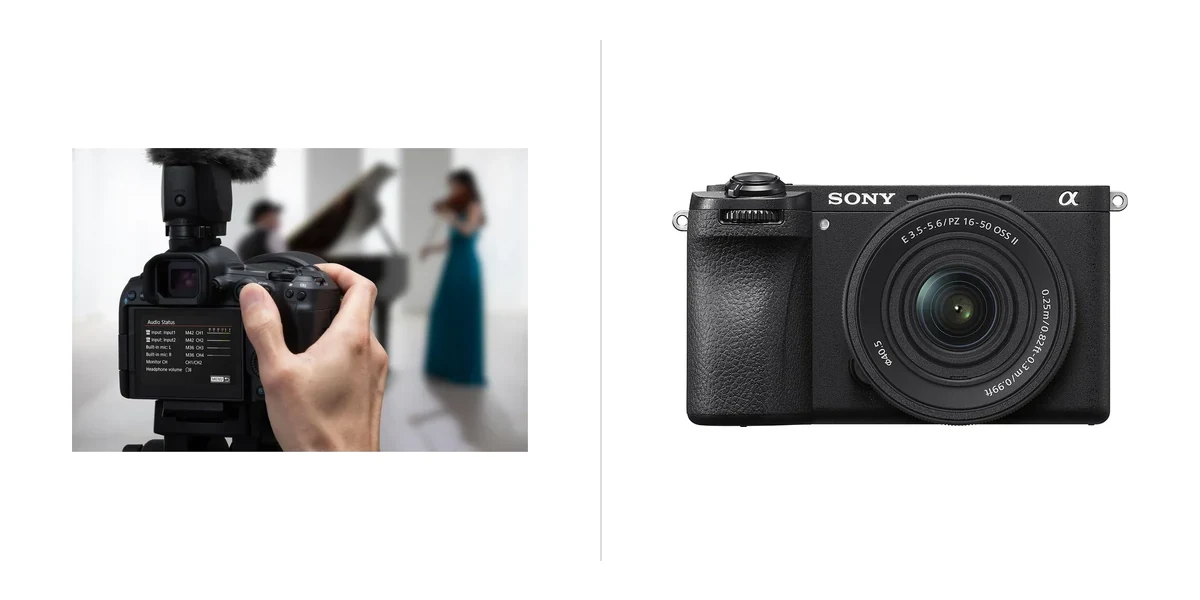
The Canon EOS R5 Mark II and Sony a6700 represent two distinct paths in the 2026 mirrorless camera market, with Canon targeting professionals who demand ultimate speed and video capability while Sony focuses on compact, high-performance hybrid shooting for enthusiasts. Both cameras excel in AI-driven autofocus and real-world image quality, yet they differ significantly in price, body design, and specialized features. This head-to-head weighs their strengths to help creators choose the right tool for their workflow.
At a Glance
| Feature | Canon EOS R5 Mark II | Sony a6700 |
|---|---|---|
| Price | $3,999 | $1,598 |
| Overall Score | 88/100 | 87/100 |
| Best For | Professional hybrid shooters needing top speed and video | Enthusiast photographers seeking compact performance |
| Autofocus | Revolutionary AI that anticipates action and maintains focus in chaotic environments | Class-leading AI subject recognition and tracking |
| Video | Finally usable 8K 60p RAW recording times thanks to vastly improved thermal management | Outstanding 4K 60p oversampled video with professional codecs |
| Image Quality | Beautiful color science and dynamic range that minimize post-production time | Strong stills image quality with excellent dynamic range for an APS-C sensor |
Design and Build
The Canon EOS R5 Mark II delivers outstanding build quality with refined ergonomics and class-leading weather sealing that inspires confidence during professional assignments in challenging conditions. By contrast, the Sony a6700 utilizes a compact, weather-sealed magnesium body with improved ergonomics and a deep grip that makes it comfortable for all-day carry while remaining far more portable than larger full-frame rivals.
Both cameras prioritize durability, yet their design philosophies diverge sharply. The Canon feels like a robust professional tool built for extended use, while the Sony’s smaller footprint and thoughtful grip enhancements make it more approachable for travel, street photography, and run-and-gun video work. Photographers who value outright toughness and refinement will appreciate the Canon, whereas those prioritizing mobility will gravitate toward the Sony’s compact form.
Performance and Features
Both cameras boast exceptional AI autofocus systems, but they emphasize different strengths. The Canon EOS R5 Mark II’s revolutionary AI autofocus anticipates action and maintains focus in chaotic environments, backed by a blazing 30 fps burst rate with virtually no blackout and exceptional subject tracking. For more details see our full review of Canon EOS R5 Mark II. The Sony a6700 counters with class-leading AI subject recognition and tracking that performs exceptionally in real-world conditions, supported by effective 5-axis IBIS that enables sharp handheld shooting in challenging conditions.
Video performance further separates the two. The Canon finally offers usable 8K 60p RAW recording times thanks to vastly improved thermal management, paired with beautiful color science and dynamic range that minimize post-production time. The Sony a6700 instead delivers outstanding 4K 60p oversampled video with professional codecs and picture profiles, making it a compelling hybrid tool. Our full review of Sony a6700 explores these video strengths in depth.
Shared weaknesses include complex menu systems that present a steep learning curve and battery life that requires planning for long shoots. The Canon’s battery, while improved, still demands spares for full-day professional assignments, while the Sony’s remains average, especially when recording extended 4K video.
Pricing and Value
Priced at $3,999, the Canon EOS R5 Mark II sits at a premium that reflects its class-leading speed, 8K video usability, and professional build quality. However, that substantial cost—combined with expensive CFexpress Type B cards—puts it out of reach for many serious enthusiasts and semi-professionals. The Sony a6700, at $1,598, delivers an overall score of 87/100 that nearly matches the Canon’s 88/100 while costing less than half as much.
For most users, the Sony a6700 offers significantly better value. It provides class-leading AI tracking, excellent 4K video, and a compact weather-sealed body that covers the majority of hybrid shooting needs without the Canon’s financial barrier. The Canon only justifies its price for those who specifically require its blazing 30 fps performance, usable 8K RAW, and refined pro ergonomics.
Pros and Cons
Canon EOS R5 Mark II
Pros:
– Blazing 30 fps burst rate with virtually no blackout and exceptional subject tracking.
– Revolutionary AI autofocus that anticipates action and maintains focus in chaotic environments.
– Finally usable 8K 60p RAW recording times thanks to vastly improved thermal management.
– Outstanding build quality with refined ergonomics and class-leading weather sealing.
– Beautiful color science and dynamic range that minimize post-production time.
Cons:
– The $4,299 price point puts it out of reach for many serious enthusiasts and semi-professionals.
– Battery life, while improved, still requires carrying spares for full-day professional assignments.
– CFexpress Type B cards remain expensive, adding significant cost to the overall workflow.
– The complex menu system, while powerful, presents a steep learning curve for newcomers.
– Some competitors offer global shutter technology that completely eliminates distortion the stacked sensor cannot.
Sony a6700
Pros:
– Class-leading AI subject recognition and tracking that performs exceptionally in real-world conditions.
– Outstanding 4K 60p oversampled video with professional codecs and picture profiles.
– Compact, weather-sealed magnesium body with improved ergonomics and deep grip.
– Effective 5-axis IBIS that enables sharp handheld shooting in challenging conditions.
– Strong stills image quality with excellent dynamic range for an APS-C sensor.
Cons:
– Electronic viewfinder resolution feels dated compared to newer 5.76M-dot panels in 2026.
– Single SD card slot may give pause to professional or event photographers.
– Battery life remains average, especially when recording extended 4K video.
– Menu system is still overly complex despite years of incremental refinements.
– No built-in flash or PC sync terminal, requiring additional accessories for studio work.
Who Should Buy Which
Professionals and serious hybrid shooters who regularly need 30 fps blackout-free bursts, anticipatory AI autofocus, and usable 8K 60p RAW should buy the Canon EOS R5 Mark II. Its refined build, class-leading weather sealing, and beautiful color science make it the clear choice for commercial work, sports, wildlife, and high-end video production where budget is secondary to performance.
Enthusiasts, travel photographers, and content creators working primarily in 4K who want excellent AI tracking and strong image quality in a compact package should choose the Sony a6700. Its combination of portability, effective IBIS, and outstanding value at $1,598 makes it ideal for everyday shooting, vlogging, and run-and-gun scenarios where the Canon’s premium features would be overkill.
Verdict
The Canon EOS R5 Mark II wins overall in 2026 by a narrow margin thanks to its blazing 30 fps burst rate, revolutionary AI autofocus that anticipates action, and finally usable 8K 60p RAW recording. These advantages, combined with outstanding build quality and beautiful color science, make it the superior tool for professional hybrid workflows despite its high price.
That said, the Sony a6700 is the better choice for the vast majority of users. At less than half the cost it delivers class-leading AI tracking, excellent 4K video, and a compact weather-sealed body that covers enthusiast and semi-professional needs with an overall score just one point behind. Buy the Canon if you need its specific pro-level strengths; otherwise the Sony a6700 represents smarter value in today’s market.