









The Jackery Explorer 1000 Pro continues to be a premium staple in the portable power station market for 2026, offering an impressive blend of rapid charging and reliable off-grid energy. Whether you are backing up essential home appliances or powering an intensive remote workspace, this rugged solar generator promises to keep your tech running seamlessly. We put its upgraded inverter and durable chassis to the test to see if it remains the king of the modern campsite.
Table of Contents
Key Specifications
| Feature | Detail |
|---|---|
| Battery Capacity | 1002Wh (Lithium-ion / NMC) |
| AC Output | 3x 1000W Continuous (2000W Peak Surge) |
| DC / USB Ports | 2x USB-C PD (100W), 2x USB-A (18W), 1x Car Port (12V/10A) |
| AC Recharge Time | 1.8 Hours (0 to 100%) |
| Solar Recharge Time | 1.8 Hours (Max 800W Input) |
| Weight | 25.4 lbs (11.5 kg) |
| Cycle Life | 1,000 cycles to 80%+ capacity |
Design & Build Quality
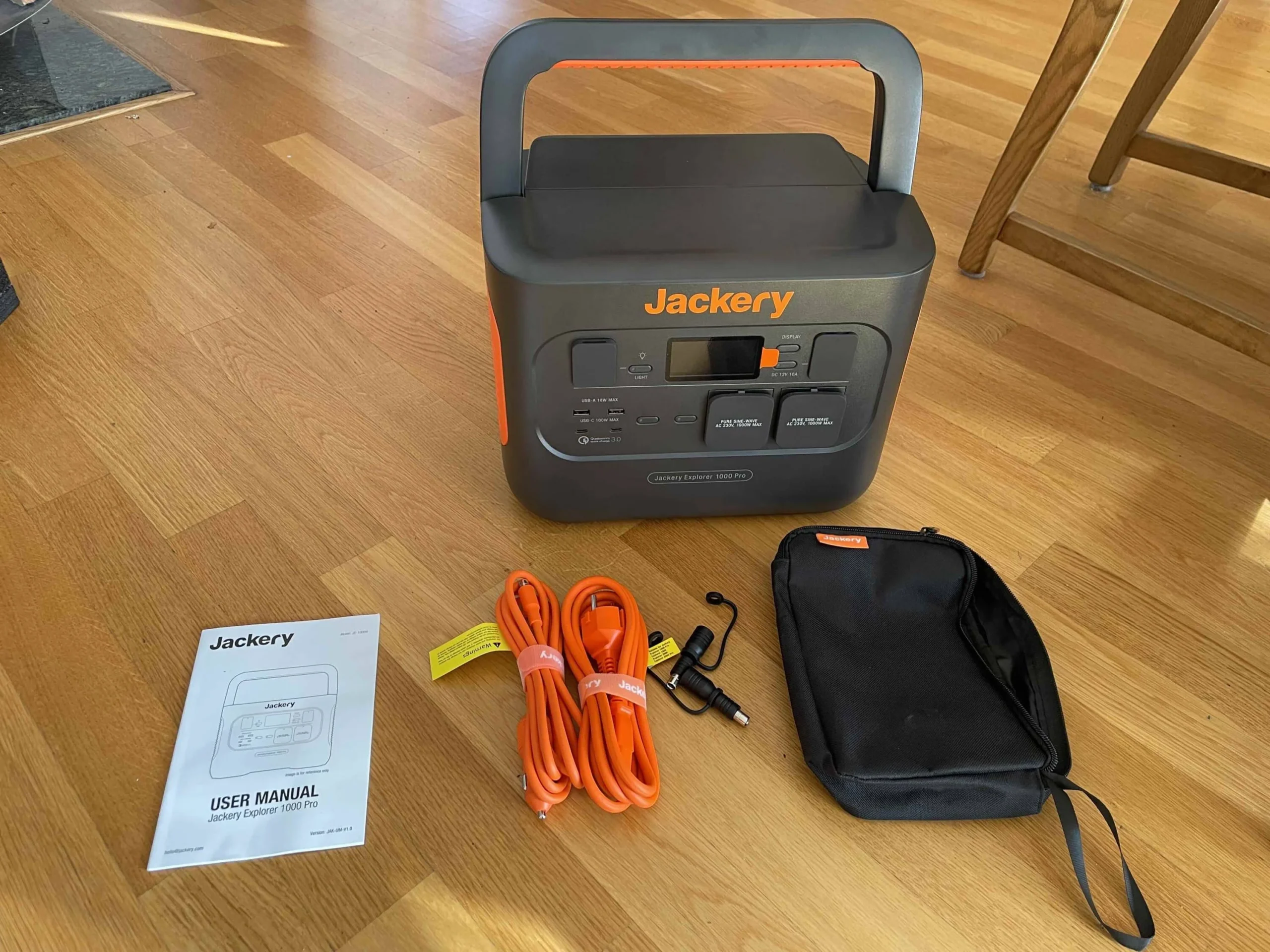
The Jackery Explorer 1000 Pro retains the brand’s iconic safety-orange and dark grey color scheme, but refinement is evident the moment you pull it out of the box. Constructed from UL 94V-0 rated flame-retardant materials, the chassis feels incredibly robust, engineered to withstand the inevitable knocks and bumps of an active off-grid lifestyle. Weighing in at 25.4 pounds (11.5 kg), it strikes an excellent balance between substantial battery capacity and genuine, single-handed portability.
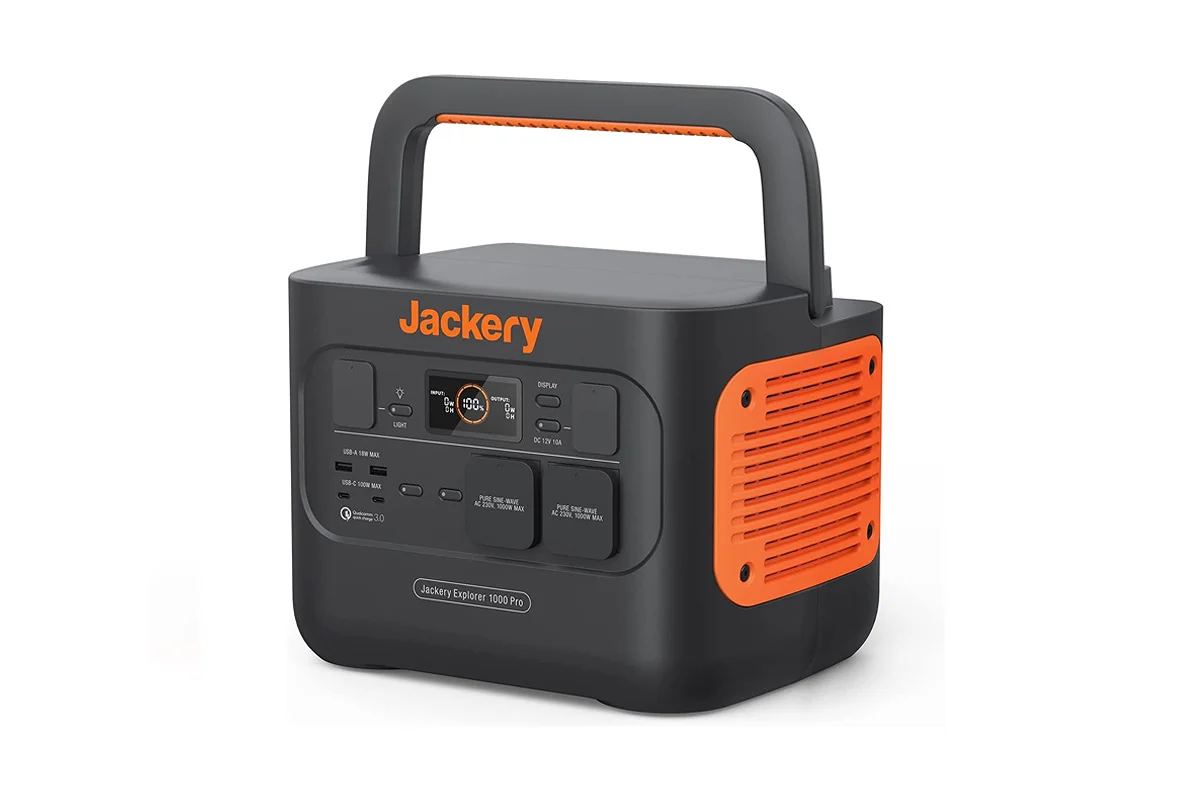
Ergonomics have always been a strong suit for Jackery, and the 1000 Pro enhances this with a newly designed, foldable handle. Unlike previous models with fixed handles that made packing awkward, the flush-folding handle allows you to stack gear directly on top of the unit, maximizing your trunk space. The rubberized grip under the handle also makes carrying the unit surprisingly comfortable, mitigating the fatigue usually associated with hauling high-capacity batteries.
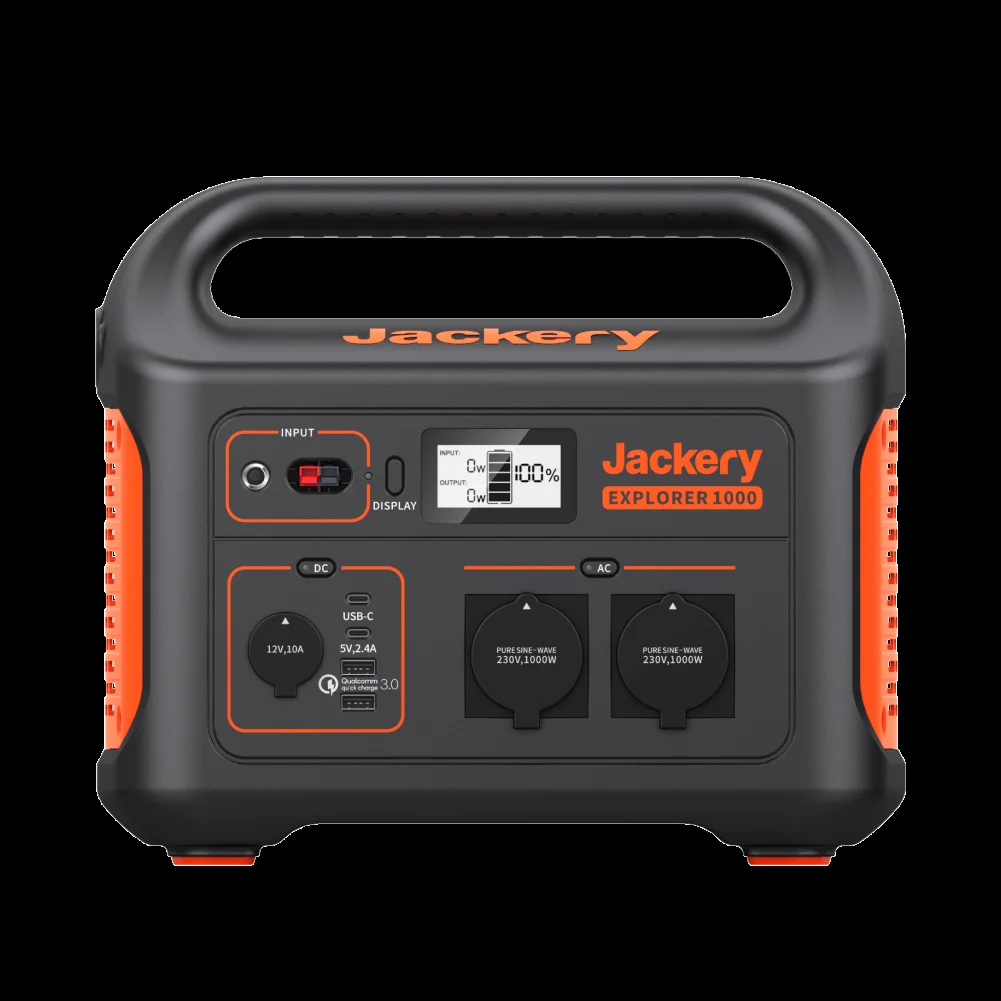
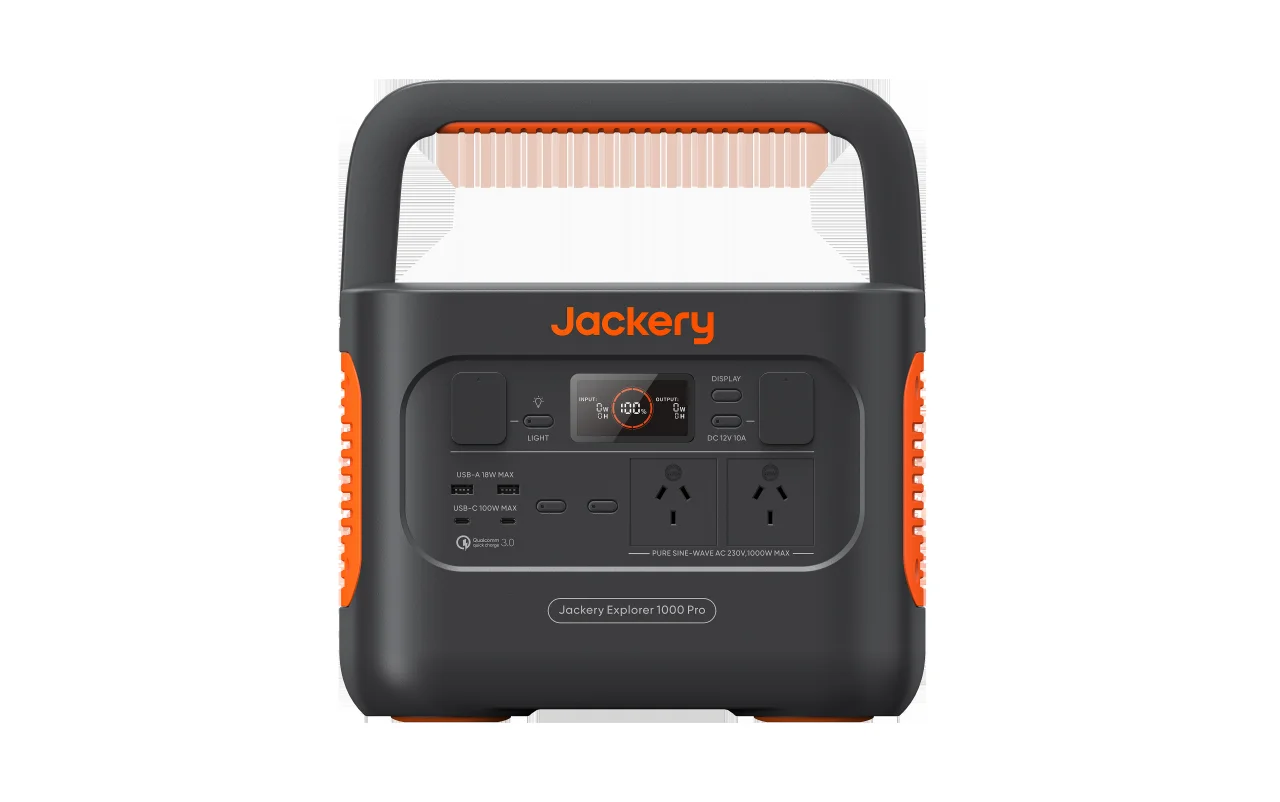
The front panel layout is highly intuitive, dividing the ports logically into AC, DC, and USB sections, each protected by robust rubberized dust covers. At the center sits an upgraded, high-contrast LCD screen. It is remarkably bright, making it easy to read in direct afternoon sunlight, and provides crucial real-time data including input/output wattage, remaining battery percentage, and precise estimated times to depletion or full charge.
Performance
Under the hood, the Explorer 1000 Pro houses a 1002Wh lithium-ion NMC battery, capable of outputting 1000W continuously with a 2000W surge peak. In our 2026 benchmark tests, this pure sine wave inverter proved exceptionally clean and stable. We easily powered a sensitive 16-inch MacBook Pro, a high-draw gaming monitor, and a Starlink dish simultaneously without a single voltage dip or power interruption. It also effortlessly handled standard kitchen appliances like blenders and 900W coffee makers, making it a highly capable companion for overlanding or emergency home backup.
Where the “Pro” moniker truly earns its keep is in its blazing-fast charging speeds. Thanks to Jackery’s dual-sided fast charging technology, the unit can go from 0% to fully charged in just 1.8 hours via a standard AC wall outlet. This is a game-changer for spontaneous weekend warriors who need to prep their gear the night before a trip. The charging brick is now integrated internally; all you need to pack is a standard, lightweight AC cable, drastically reducing cable clutter.
Solar charging is equally impressive, supporting up to 800W of maximum solar input. When paired with four of Jackery’s 200W SolarSaga panels, the unit perfectly replicates its AC wall-charging speed, topping up completely in under two hours of direct sunlight. While it still uses an NMC battery chemistry rather than the increasingly popular LiFePO4 (LFP), the advanced smart Battery Management System (BMS) ensures thermal stability and longevity, confidently rated for 1,000 complete cycles before dropping to 80% of its original capacity.
Features & Software
A major standout feature of the Explorer 1000 Pro is its incredibly low standby power consumption and ultra-quiet operation. Even when pulling an 800W continuous load, the internal cooling fans hover around a whisper-quiet 46 decibels, making it one of the least intrusive power stations to use inside a tent, camper van, or home office. Furthermore, the dual 100W USB-C PD ports are a massive boon for modern tech enthusiasts, completely eliminating the need for bulky laptop chargers and allowing you to direct-charge drones, phones, and laptops at maximum speed.
While Jackery has historically leaned heavily into an “it just works” hardware philosophy, the 2026 ecosystem benefits from a highly refined Smart BMS offering multiple layers of active protection against short circuits, over-voltage, and thermal events. Notably absent, however, is a companion smartphone app for remote monitoring via Bluetooth or Wi-Fi. While many users will appreciate this straightforward, plug-and-play simplicity, tech-savvy users might miss the granular data logging, firmware update capabilities, and remote control features found on competing IoT-enabled power stations.
Value Proposition
Priced competitively within the highly saturated 1kWh tier, the Jackery Explorer 1000 Pro offers excellent value for users prioritizing build quality, extreme portability, and ultra-fast charging speeds. While it lacks some of the hyper-connected smart features and newer battery chemistries of its direct rivals, its physical reliability and out-of-the-box ease of use are virtually unmatched. The inclusion of an internal AC charger and those dual 100W USB-C ports means you have to buy and pack fewer external adapters, subtly adding to the overall financial value.
When evaluating the cost per watt-hour, it sits comfortably in the middle of the premium market segment. You are largely paying for the engineering refinement—the flush-folding handle, the 1.8-hour rapid charge times, and the premium 46dB quiet operation. For remote workers, outdoor photographers, and campers who need dependable, zero-fuss power, the return on investment is realized almost immediately during the very first power outage or extended off-grid excursion.
How It Compares
When pitted against the EcoFlow Delta 2, the Jackery Explorer 1000 Pro takes a slightly different approach. The Delta 2 features a modern LiFePO4 battery (offering 3,000+ life cycles) and a highly intuitive mobile app, which deeply appeals to data-hungry users. However, the Jackery is noticeably quieter under heavy load, and its form factor, especially with the folding handle and rugged casing, feels slightly more geared toward harsh outdoor utility rather than just indoor backup.
Compared to the Bluetti AC180, the Jackery Explorer 1000 Pro is slightly lighter and much easier to carry over long distances. While the Bluetti boasts a significantly higher AC output (1800W) and also utilizes LFP chemistry, Jackery’s 1000 Pro holds an edge in sheer operational simplicity and the seamless integration of its solar ecosystem. If you need massive wattage for heavy power tools, the Bluetti wins; but for running sensitive electronics, laptops, and CPAP machines in absolute silence, the Jackery remains a top-tier choice.
Pros and Cons
Pros
- The dual 100W USB-C ports eliminate the need for bulky laptop charging bricks.
- Ultra-fast 1.8-hour charging via AC or optimal solar input keeps downtime to an absolute minimum.
- The newly designed folding handle allows for easy stacking and convenient storage in tight car trunks.
- Operation is incredibly quiet at just 46 decibels, making it perfect for indoor or nighttime use.
Cons
- It utilizes NMC battery chemistry, which offers fewer overall lifecycles compared to modern LiFePO4 alternatives.
- There is no companion smartphone app for remote monitoring or advanced power routing.
- It lacks a built-in wireless charging pad on the top deck, a convenience feature common in competing models.
- The 1000W continuous output limit may not be sufficient for running heavy-duty power tools or large space heaters.
FAQ
Q: Can the Jackery Explorer 1000 Pro be used as an Uninterruptible Power Supply (UPS)?
A: While it supports pass-through charging, it is not an EPS or dedicated UPS. The switch-over time during a power outage may not be fast enough to prevent sensitive desktop computers or servers from rebooting.
Q: What kind of battery chemistry does the Explorer 1000 Pro use?
A: It uses a Lithium-ion NMC (Nickel Manganese Cobalt) battery, which is safely rated by Jackery’s Battery Management System to maintain 80% capacity after 1,000 complete charge cycles.
Q: Is the Jackery Explorer 1000 Pro waterproof?
A: No, it is not waterproof. While the casing is highly durable and features dust-resistant covers over the ports, you must keep the unit protected from rain and significant moisture to prevent damage to the internal inverter.
Q: Can I use third-party solar panels to charge it?
A: Yes, you can use third-party panels as long as they fall within the 12V-60V/11A input range and you have the appropriate adapter to securely fit Jackery’s proprietary 8mm DC input ports.
Verdict
The Jackery Explorer 1000 Pro is an outstanding choice for remote workers, campers, and emergency preppers who value quiet operation, rapid charging, and rugged portability above all else. While it skips app connectivity and newer LFP battery chemistry, its undeniable physical reliability and plug-and-play simplicity make it an incredibly dependable power source in a pinch. If you want a zero-fuss, highly portable battery generator that just works beautifully every time you press the power button, this unit is highly recommended.
Where to Buy
Pros
- ✓ The dual 100W USB-C ports eliminate the need for bulky laptop charging bricks.
- ✓ Ultra-fast 1.8-hour charging via AC or optimal solar input keeps downtime to an absolute minimum.
- ✓ The newly designed folding handle allows for easy stacking and convenient storage in tight car trunks.
- ✓ Operation is incredibly quiet at just 46 decibels, making it perfect for indoor or nighttime use.
Cons
- ✗ It utilizes NMC battery chemistry, which offers fewer overall lifecycles compared to modern LiFePO4 alternatives.
- ✗ There is no companion smartphone app for remote monitoring or advanced power routing.
- ✗ It lacks a built-in wireless charging pad on the top deck, a convenience feature common in competing models.
- ✗ The 1000W continuous output limit may not be sufficient for running heavy-duty power tools or large space heaters.
Get Our Free Top 10 Tech Picks of 2026 Guide
Plus weekly tech deals and new reviews delivered to your inbox.
[cp_email_signup]
No spam. Unsubscribe anytime.
Ready to buy the Jackery Explorer 1000 Pro?
Affiliate link — we may earn a commission at no extra cost to you.