


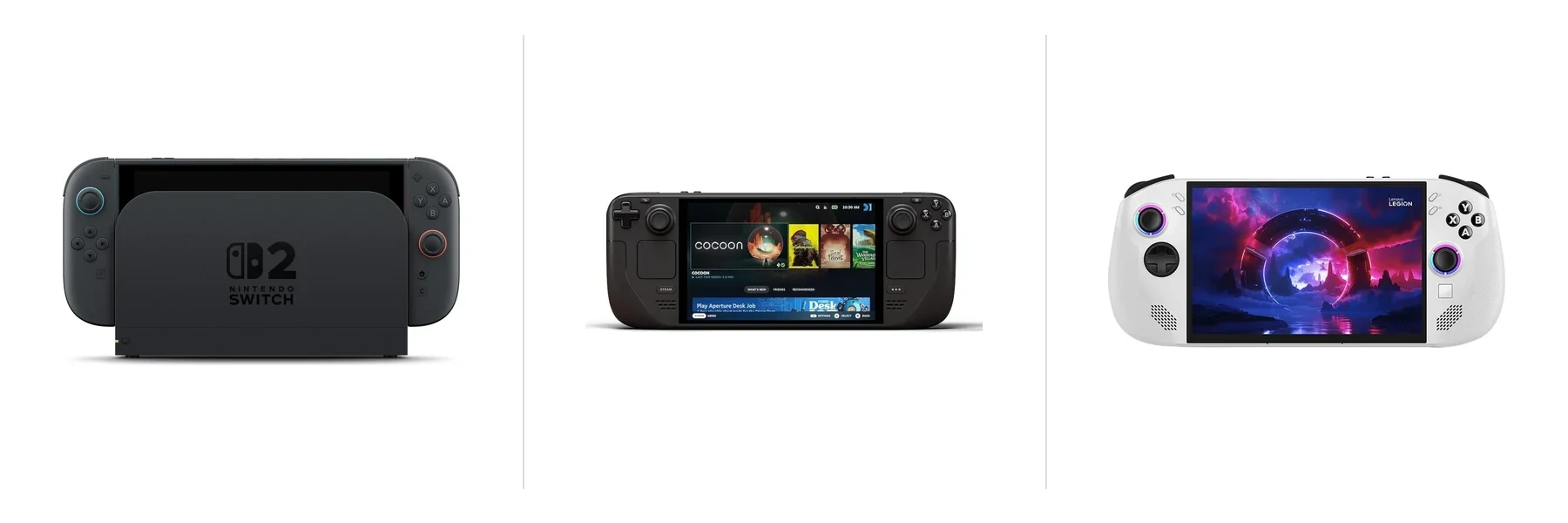
As the handheld gaming market matures in 2026, the Nintendo Switch 2, Valve Steam Deck OLED, and Lenovo Legion Go S SteamOS represent three distinct philosophies for portable play. Nintendo refines its hybrid ecosystem with innovative controls and AI-enhanced visuals, while Valve emphasizes versatility and display fidelity within the Steam library, and Lenovo delivers uncompromising AAA performance through native SteamOS. This matchup explores which device best balances everyday enjoyment against raw capability.
At a Glance
| Feature | Nintendo Switch 2 | Valve Steam Deck OLED | Lenovo Legion Go S SteamOS |
|---|---|---|---|
| Price | $449 | $1,320 | $1,472.35 |
| Overall Score | 91/100 | 87/100 | 86/100 |
| Best For | Nintendo ecosystem & backward compatibility | Versatile Steam library & productivity | High-performance AAA gaming |
| Display | 8-inch 120Hz OLED | HDR OLED with stunning contrast | Crisp 165Hz QHD+ |
| Key Strength | Magnetic Joy-Cons, DLSS & AI upscaling | Desktop mode & improved battery life | AMD performance & strong thermals |
| Ergonomics | Refined premium build | Exceptional but heavier at 669g | Premium but heaviest at 795g |
Design and Build
The Nintendo Switch 2 stands out with its magnetic Joy-Cons featuring Hall-effect sensors that completely eliminate drift while offering improved attachment security. Combined with refined ergonomics and premium build quality, it remains comfortable for extended play sessions, as detailed in our full review of Nintendo Switch 2.
Both the Valve Steam Deck OLED and Lenovo Legion Go S SteamOS deliver exceptional ergonomics and premium build quality that support long gaming sessions. However, the Steam Deck’s 669-gram weight and the Legion Go S’s 795g heft make them noticeably heavier than lighter competitors, potentially causing fatigue during marathon sessions despite their strong thermal designs.
Performance and Features
The Lenovo Legion Go S SteamOS leads in raw capability with its outstanding performance from the AMD Z2 Extreme APU that easily handles modern AAA titles at high settings. Its crisp 165Hz QHD+ display delivers vibrant colors and smooth motion that surpasses the Steam Deck, while the strong thermal design keeps the device relatively cool and quiet. Native SteamOS provides a seamless, console-like experience with excellent Proton compatibility, though some non-Steam titles still require community workarounds. Our full review of Lenovo Legion Go S SteamOS confirms its strengths for demanding games.
The Valve Steam Deck OLED counters with access to Steam’s massive library and versatile desktop mode that transforms the device into a capable portable PC for work and productivity. Improved battery life and thermal efficiency provide better sustained performance than its predecessor, though demanding AAA titles still require graphical compromises. Our full review of Valve Steam Deck OLED praises its HDR OLED display for stunning contrast and color accuracy.
The Nintendo Switch 2 leverages NVIDIA DLSS and AI upscaling technology for impressive visual fidelity even in demanding modern games, supported by an 8-inch 120Hz OLED display with vibrant colors and smooth motion. Exceptional backward compatibility grants instant access to a massive library of existing Switch titles, though some third-party developers have been slow to optimize their largest titles. Docked 4K output relies on AI upscaling rather than native rendering.
Pricing and Value
Priced at $449, the Nintendo Switch 2 delivers significantly better value than the Valve Steam Deck OLED at $1,320 or the Lenovo Legion Go S SteamOS at $1,472.35. Its combination of premium features, highest overall score, and much lower entry point makes it accessible to a broader audience while still offering refined ergonomics, drift-free controls, and AI-enhanced visuals.
The two SteamOS devices command premium pricing that reflects their more powerful hardware and open PC gaming approach, but the substantial cost difference may only be justified for enthusiasts who specifically need AAA performance or desktop versatility. For most gamers, the Switch 2 provides superior balance between capability and cost.
Pros and Cons
Nintendo Switch 2
Pros:
– Magnetic Joy-Cons with Hall-effect sensors completely eliminate drift while offering improved attachment security.
– The 8-inch 120Hz OLED display delivers vibrant colors and smooth motion that enhance every gaming experience.
– Exceptional backward compatibility provides instant access to a massive library of existing Switch titles.
– NVIDIA DLSS and AI upscaling technology allow impressive visual fidelity even in demanding modern games.
– Refined ergonomics and premium build quality make it comfortable for extended play sessions.
Cons:
– The $399 launch price represents a significant increase over the original Switch, potentially deterring budget-conscious buyers.
– Docked 4K output relies on AI upscaling rather than native rendering, which may disappoint purists.
– Nintendo’s traditional approach to online services still requires a paid subscription for most multiplayer features.
– The microSD Express card format, while fast, limits storage upgrade options to more expensive proprietary cards.
– Some third-party developers have been slow to optimize their largest titles for the new hardware.
Valve Steam Deck OLED
Pros:
– The HDR OLED display delivers stunning contrast and color accuracy that elevates every game.
– Exceptional ergonomics and build quality make it comfortable for extended gaming sessions.
– Access to Steam’s massive library with excellent compatibility through ongoing Proton updates.
– Versatile desktop mode transforms the device into a capable portable PC for work and productivity.
– Improved battery life and thermal efficiency provide better sustained performance than the original model.
Cons:
– The 1280×800 resolution can appear soft when connected to larger 4K external displays.
– Demanding AAA titles still require graphical compromises to maintain playable frame rates.
– At 669 grams, the device feels somewhat heavy compared to newer lightweight competitors.
– Some multiplayer titles with kernel-level anti-cheat remain unsupported on SteamOS.
– Limited RAM and non-upgradable APU may impact longevity as game requirements increase.
Lenovo Legion Go S SteamOS
Pros:
– Outstanding performance from the AMD Z2 Extreme APU easily handles modern AAA titles at high settings.
– Crisp 165Hz QHD+ display delivers vibrant colors and smooth motion that surpasses the Steam Deck.
– Native SteamOS provides a seamless, console-like experience with excellent Proton compatibility.
– Premium build quality and refined ergonomics make it comfortable for long gaming sessions.
– Strong thermal design keeps the device relatively cool and quiet under load.
Cons:
– Battery life is average at best, dropping to 3-4 hours with demanding modern games.
– The 795g weight makes it noticeably heavier than both the Steam Deck and ROG Ally X.
– Some non-Steam titles still require community workarounds or launch options on SteamOS.
– Premium pricing positions it above the most affordable handheld options.
– Limited access to certain Windows-only Lenovo utilities due to the Linux-based OS.
Who Should Buy Which
Nintendo Switch 2 is the clear choice for Nintendo fans and families who value instant access to a massive existing game library, drift-free controls, and a vibrant 120Hz OLED display without spending over $500. Its refined ergonomics and AI upscaling make it ideal for extended portable or docked play sessions where convenience and visual polish matter most.
Valve Steam Deck OLED suits PC gamers who want a versatile all-in-one device that excels at both gaming and productivity. Those who prioritize Steam’s massive library, HDR visuals, desktop mode, and improved battery life will appreciate its flexibility despite the higher $1,320 price and heavier build.
Lenovo Legion Go S SteamOS targets enthusiasts seeking maximum performance for modern AAA titles at high settings. Buyers comfortable with its $1,472.35 premium price, heavier 795g weight, and average battery life will benefit from the crisp 165Hz display, strong thermals, and seamless SteamOS experience.
Verdict
The Nintendo Switch 2 wins overall in 2026 thanks to its highest 91/100 score, innovative magnetic Joy-Cons, excellent 120Hz OLED display, DLSS technology, and dramatically lower $449 price point that delivers superior value for the majority of gamers. It particularly excels for anyone invested in the Nintendo ecosystem or seeking the best balance of comfort and backward compatibility.
The Valve Steam Deck OLED is best for users needing desktop mode versatility and HDR fidelity within the Steam library. The Lenovo Legion Go S SteamOS wins for raw AAA performance enthusiasts willing to pay a premium for its powerful APU and high-refresh display, despite shorter battery life.