

In the competitive 2026 mid-range GPU market, the ASRock Challenger Radeon RX 7600 OC and NVIDIA GeForce RTX 5060 battle for 1440p gaming supremacy with distinctly different approaches. The AMD card delivers strong factory-overclocked performance and excellent value at a lower price, while the NVIDIA option focuses on AI-driven upscaling, efficiency, and premium features. This head-to-head breaks down which card makes more sense for your build.
At a Glance
| Feature | ASRock Challenger Radeon RX 7600 OC | NVIDIA GeForce RTX 5060 |
|---|---|---|
| Price | $279.99 | $359.99 |
| Overall Score | 82/100 | 81/100 |
| Best For | Value-focused 1440p gaming | Efficient 1440p with advanced upscaling |
| VRAM | 8GB (may limit longevity) | 8GB (limiting in future titles) |
| Cooling | Excellent thermal and acoustic dual-fan design | Premium cooling solution, highly efficient 160W TDP |
| Key Software | Mature AMD ecosystem with FSR 3.1 | DLSS 4 with transformer AI and creator support |
Design and Build
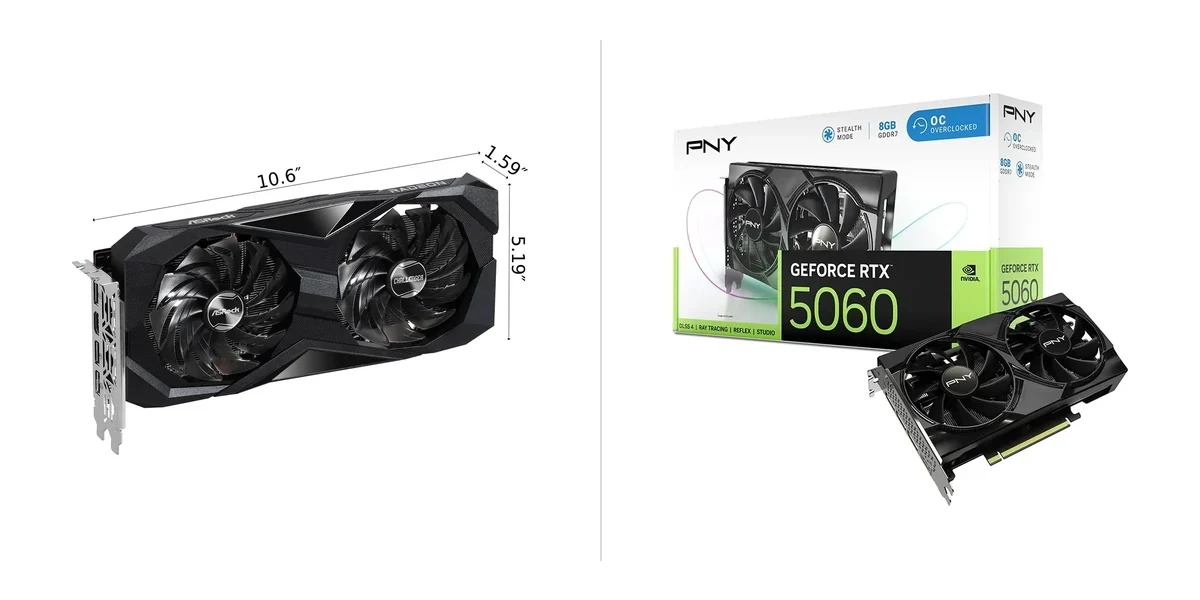
The ASRock Challenger Radeon RX 7600 OC impresses with its compact dimensions and dual-fan cooler design that delivers excellent thermal and acoustic performance, making it an ideal choice for smaller PC cases. It skips RGB lighting and premium aesthetics, resulting in a straightforward appearance that prioritizes function over flash.
In contrast, the NVIDIA GeForce RTX 5060 features a premium cooling solution that maintains low temperatures and operates quietly under load. Its highly efficient 160W TDP enables compact builds with lower power consumption, though the lack of a Founders Edition model may lead to higher prices from partners and slightly less consistency in build quality across versions.
Performance and Features
The ASRock Challenger Radeon RX 7600 OC brings noticeable performance gains through its factory overclock, delivering strong value for 1440p gaming backed by AMD’s mature software ecosystem and regular driver support with FSR 3.1. However, its ray tracing performance lags behind similarly priced NVIDIA cards, it shows occasional micro-stuttering in CPU-bound scenarios, and the 8GB of VRAM may limit longevity as textures grow larger. It is not ideal for consistent 4K gaming.
The NVIDIA GeForce RTX 5060 stands out with exceptional 1440p performance, maintaining stable high frame rates in demanding titles thanks to DLSS 4 and its transformer AI model that provides class-leading image quality and performance gains. The card’s excellent software ecosystem offers regular updates and strong creator application support, while the premium cooling keeps noise and temperatures in check. On the downside, ray tracing still relies heavily on DLSS for optimal results, and the 8GB of VRAM shows limitations in memory-intensive workloads and future titles at higher resolutions.
Both cards share similar VRAM constraints, but their feature philosophies differ significantly: AMD focuses on broad compatibility and value, while NVIDIA emphasizes AI-enhanced visuals and efficiency.
Pricing and Value
At $279.99, the ASRock Challenger Radeon RX 7600 OC delivers a stronger value proposition in 2026 for 1440p gaming, especially with its higher overall score and competitive pricing that undercuts the NVIDIA card by $80. Its factory overclock and solid thermal design give most gamers excellent performance per dollar without sacrificing everyday usability.
The NVIDIA GeForce RTX 5060 at $359.99 carries a higher cost that reflects its DLSS 4 technology, superior efficiency, and premium cooling. While its launch pricing represents an increase over the previous generation and the lack of a Founders Edition can push real-world prices even higher, the card’s advantages in image quality and creator workloads may justify the premium for users who specifically need those capabilities. For pure gaming value, the ASRock currently holds the edge.
Pros and Cons
ASRock Challenger Radeon RX 7600 OC
Pros:
– Factory overclock delivers noticeable performance gains over reference RX 7600 cards.
– Excellent thermal and acoustic performance with its dual-fan cooler design.
– Strong value proposition in 2026 with competitive pricing for 1440p gaming.
– Mature AMD software ecosystem with regular driver support and FSR 3.1.
– Compact dimensions make it suitable for smaller PC cases.
Cons:
– Only 8GB of VRAM may limit longevity as game textures continue to grow in size.
– Ray tracing performance lags behind similarly priced NVIDIA alternatives.
– Lacks RGB lighting and premium aesthetics found on more expensive models.
– Occasional micro-stuttering reported in certain CPU-bound scenarios.
– Not ideal for users targeting consistent 4K gaming performance.
NVIDIA GeForce RTX 5060
Pros:
– Delivers exceptional 1440p performance with stable high frame rates in demanding titles.
– DLSS 4 with transformer AI provides class-leading image quality and performance gains.
– Highly efficient 160W TDP enables compact builds and lower power consumption.
– Premium cooling solution maintains low temperatures and operates quietly under load.
– Excellent software ecosystem with regular updates and strong creator application support.
Cons:
– 8GB of VRAM may become limiting in future titles at higher resolutions or texture packs.
– Launch pricing at $299 represents an increase compared to the RTX 4060’s original MSRP.
– No Founders Edition model is available, potentially leading to higher prices from partners.
– Some memory-intensive workloads show less headroom than cards equipped with 12GB or more.
– Ray tracing performance still relies heavily on DLSS to achieve optimal frame rates in demanding scenes.
Who Should Buy Which
Buy the ASRock Challenger Radeon RX 7600 OC if you want maximum performance per dollar in 1440p gaming, need a compact card for a small case, and primarily use FSR upscaling. It’s the smart pick for budget-conscious gamers who don’t prioritize ray tracing or content creation features and appreciate the card’s quiet dual-fan cooling.
Choose the NVIDIA GeForce RTX 5060 if you value class-leading DLSS 4 image quality, require strong creator application support, or want the most power-efficient card for a compact and quiet build. It’s best for enthusiasts willing to spend extra for superior upscaling, stable frame rates in demanding titles, and NVIDIA’s polished software ecosystem.
Verdict
The ASRock Challenger Radeon RX 7600 OC wins overall in 2026 thanks to its higher review score, significantly lower $279.99 price, strong factory-overclocked performance, and excellent cooling that together deliver better value for the majority of 1440p gamers. The NVIDIA GeForce RTX 5060 excels in specific use cases where DLSS 4, power efficiency, and creator tools matter most, but the $80 premium is difficult to justify when the two cards are so close in overall capability. For most buyers, the ASRock Challenger Radeon RX 7600 OC is the clearer recommendation.