






If you are looking to upgrade your home lab or small business network in 2026, the QNAP TS-453D NAS remains a highly capable contender. Offering dual 2.5GbE ports and robust PCIe expansion, it delivers premium networking speeds without breaking the bank. Read our in-depth review to see if this four-bay powerhouse is still the ultimate storage solution for tech enthusiasts.
Table of Contents
Key Specifications
| Feature | Detail |
|---|---|
| CPU | Intel Celeron J4125 quad-core 2.0 GHz (burst up to 2.7 GHz) |
| System Memory | 4GB or 8GB SO-DIMM DDR4 (Expandable) |
| Drive Bays | 4 x 3.5-inch/2.5-inch SATA 6Gb/s |
| Networking | 2 x 2.5GbE (RJ45) |
| Expansion Slot | 1 x PCIe Gen 2 x2 |
| Video Output | 1 x HDMI 2.0 (up to 4K @ 60Hz) |
| USB Ports | 2 x USB 3.2 Gen 2, 3 x USB 2.0 |
Design & Build Quality
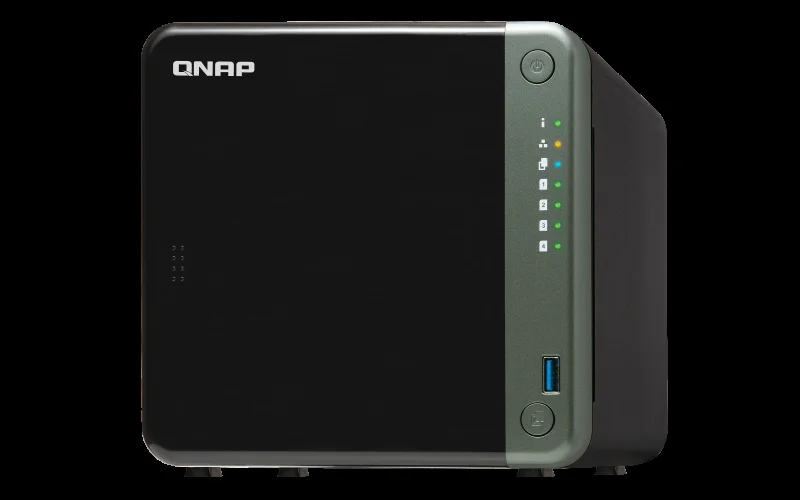
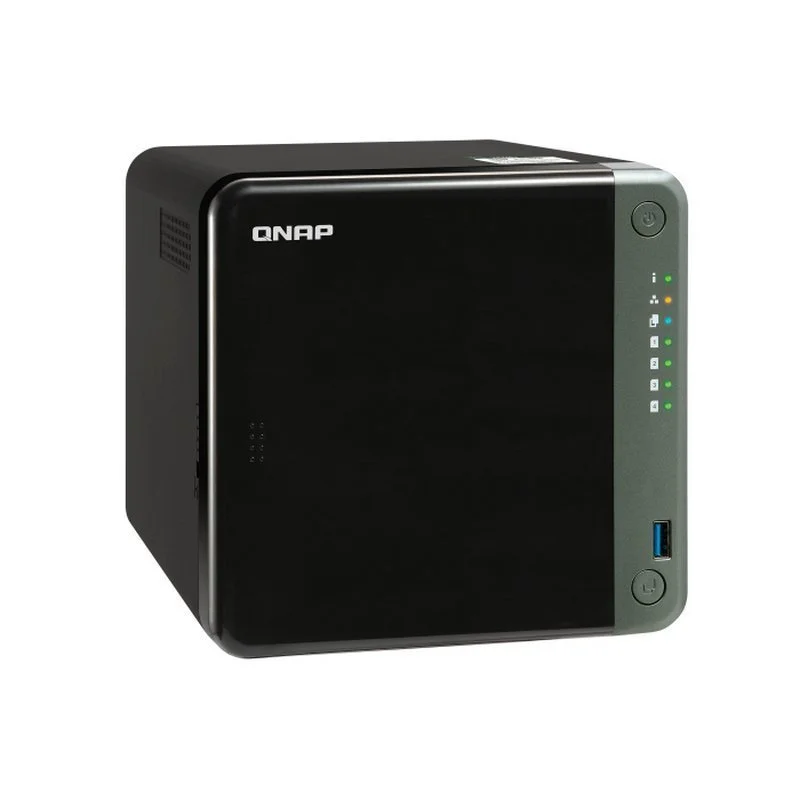
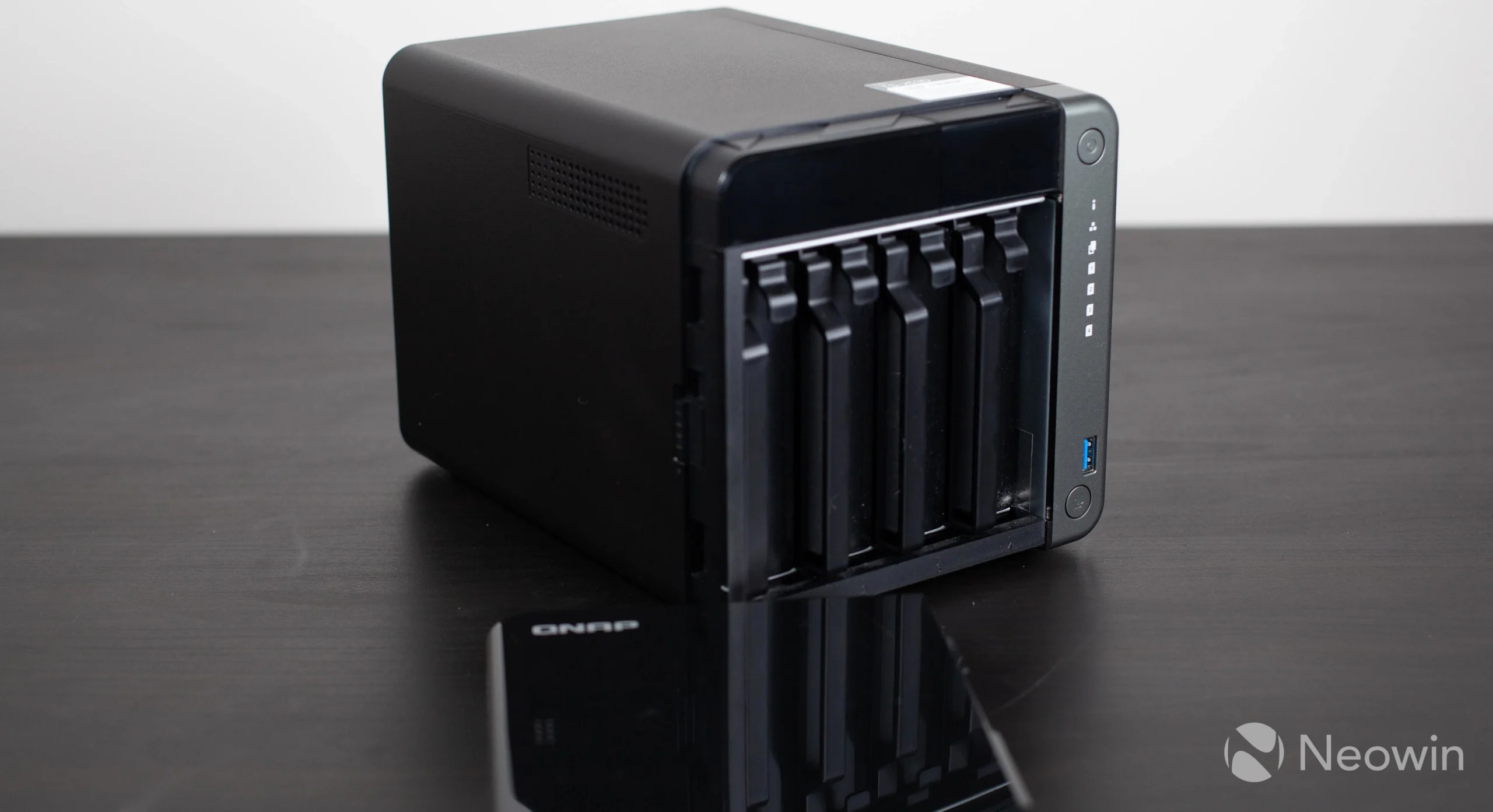
The QNAP TS-453D departs from the purely utilitarian look of older enterprise boxes, sporting a modern, sleek aesthetic that fits seamlessly into both server racks and living room setups. The front bezel features a sliding translucent plastic cover that cleverly hides the four drive bays, giving the unit a streamlined and sophisticated appearance. Behind this cover, the tool-less plastic drive sleds lock securely into a highly durable metal chassis, balancing lightweight accessibility with long-term structural integrity.
Ergonomics and physical connectivity are where this unit truly shines for power users. The front panel provides quick access to a USB 3.2 Gen 2 port alongside a convenient one-touch copy button, which is ideal for rapid, offline backups from external drives. Heat dissipation is handled effectively by a single, ultra-quiet 120mm rear exhaust fan that ensures the internal components and drives remain well within safe operating temperatures, even under heavy read/write loads.
Around the back, the layout is cleanly organized to maximize connectivity. You are greeted with dual 2.5GbE ports, an HDMI 2.0 output for direct media playback, and the highly coveted PCIe expansion slot. This thoughtful hardware engineering future-proofs the system, allowing users to eventually slot in 10GbE network cards or M.2 NVMe adapters as their data needs evolve.
Performance
Under the hood, the TS-453D is powered by the proven Intel Celeron J4125 quad-core processor clocked at 2.0 GHz, which boosts up to 2.7 GHz during heavy tasks. Paired with up to 8GB of DDR4 RAM, this NAS handles intensive multitasking, background indexing, and multiple concurrent users with impressive grace. In real-world file transfers, the dual 2.5GbE network interfaces are the star of the show. When utilizing link aggregation or SMB Multichannel over a compatible switch, read and write speeds easily saturate the 5Gbps theoretical limit, comfortably pushing past 580 MB/s for large sequential files.
For media enthusiasts and virtualization hobbyists operating in 2026, the multimedia performance remains remarkably resilient. The integrated Intel UHD Graphics 600 breezes through hardware-accelerated 4K Plex transcoding, effortlessly handling multiple high-bitrate streams simultaneously without pinning the CPU at maximum usage. Docker containers and lightweight virtual machines deployed via Container Station run incredibly smoothly, making it a brilliant mini-server for self-hosted applications, ad-blockers, and smart home hubs.
Benchmark testing confirms that the TS-453D is fundamentally built for speed. Even when populated with high-capacity mechanical hard drives rather than solid-state drives, the baseline input/output operations for countless smaller files—like massive photography libraries or localized code repositories—feel notably snappier than traditional Gigabit-constrained alternatives. Should you eventually upgrade to a 10GbE PCIe card, you can fully unlock its enterprise-grade potential, though the stock multi-gigabit speeds are more than plenty for modern prosumer environments.
Features & Software
The excellent hardware is elevated by QNAP’s mature QTS operating system, which continues to offer a rich, desktop-like experience tailored specifically for advanced users. QTS provides an overwhelming degree of granular control over your storage pools, networking, and user permissions. It features a robust application ecosystem that includes Hybrid Backup Sync (HBS 3) for executing foolproof 3-2-1 backup strategies, Qsirch for lightning-fast AI-driven file searches, and Virtualization Station for running full Windows or Linux environments directly on the NAS.
What truly sets this system apart from standard network storage is its direct-attached capabilities. The inclusion of an HDMI 2.0 port allows you to output 4K resolution at a buttery-smooth 60Hz directly to a monitor or television, effectively turning the NAS into an independent home theater PC or a localized surveillance station via QVR Pro. While QTS has a steeper learning curve compared to some rival systems, tech-savvy users will deeply appreciate the extensive hypervisor support, deep customization, and complete lack of artificial software limitations.
Value Proposition
While the NAS market in 2026 has seen an influx of newer processors, the QNAP TS-453D holds an exceptional value proposition as a tested, highly capable networking machine. Unlike entry-level boxes that force you to replace the entire unit to achieve faster networking, the inclusion of default 2.5GbE and an open PCIe slot means the total cost of ownership is brilliantly spread out over time. You are paying for a versatile platform that can seamlessly grow alongside your home bandwidth and expanding storage demands over the next decade.
How It Compares
The most frequent comparison for this model is against the Synology DS920+ and its successor, the DS923+. While Synology’s DSM software remains the gold standard for pure user-friendliness and beginner appeal, QNAP dominates in sheer hardware value. The DS920+ relies on standard Gigabit Ethernet and lacks PCIe expansion entirely, severely capping its networking potential. Even against the newer DS923+, which offers a proprietary 10GbE add-on but ditches integrated graphics entirely (effectively crippling hardware media transcoding), the TS-453D strikes a much better balance. It is perfectly positioned for prosumers who demand multi-gig speeds and robust 4K media handling out of the box without sacrificing an Intel iGPU.
Pros and Cons
Pros
- Dual 2.5GbE ports provide immediate, multi-gig network speed upgrades right out of the box.
- The PCIe Gen 2 x2 expansion slot allows for easy future-proofing with 10GbE or M.2 NVMe SSD caching cards.
- The integrated Intel iGPU handles 4K hardware media transcoding flawlessly for media servers like Plex.
- An HDMI 2.0 output enables direct connectivity to 4K displays and televisions without needing a separate PC.
Cons
- The QTS operating system has a notably steeper learning curve for networking beginners compared to Synology’s DSM.
- Upgrading the RAM can be slightly cumbersome, requiring users to remove the hard drives to access the SO-DIMM slots.
- The sliding translucent plastic front cover feels slightly flimsy compared to the incredibly robust metal chassis underneath.
- Boot times and firmware application take noticeably longer than competing devices in the same tier.
FAQ
Q: Can I upgrade the RAM on the QNAP TS-453D?
A: Yes, the NAS officially supports up to 8GB of DDR4 memory via two SO-DIMM slots, though many users have successfully installed 16GB or 32GB kits to run memory-intensive virtual machines.
Q: Does the TS-453D have built-in M.2 NVMe slots for SSD caching?
A: No, the unit does not feature built-in M.2 slots on the motherboard. However, you can easily add M.2 caching capabilities by installing a compatible QNAP QM2 expansion card into the available PCIe slot.
Q: Is the TS-453D good for running a Plex Media Server?
A: Absolutely. Thanks to the Intel Celeron J4125 processor and its integrated UHD 600 graphics, the NAS excels at hardware-accelerated transcoding for multiple simultaneous 4K and 1080p Plex streams.
Q: Can I connect this NAS directly to my television?
A: Yes. The inclusion of an HDMI 2.0 port allows you to connect the NAS directly to a 4K TV or monitor, enabling it to function as a standalone media player using apps like HD Station.
Verdict
The QNAP TS-453D is a powerhouse built for tech enthusiasts, content creators, and prosumers who demand high-speed networking alongside deep hardware customization. Its winning combination of out-of-the-box 2.5GbE, PCIe expandability, and powerful 4K transcoding makes it a superior hardware investment over many heavily restricted competitors. If you want maximum performance for your dollar and aren’t afraid to dive into a feature-dense operating system, this four-bay NAS is an outstanding choice.
Where to Buy
Pros
- ✓ Dual 2.5GbE ports provide immediate, multi-gig network speed upgrades right out of the box.
- ✓ The PCIe Gen 2 x2 expansion slot allows for easy future-proofing with 10GbE or M.2 NVMe SSD caching cards.
- ✓ The integrated Intel iGPU handles 4K hardware media transcoding flawlessly for media servers like Plex.
- ✓ An HDMI 2.0 output enables direct connectivity to 4K displays and televisions without needing a separate PC.
Cons
- ✗ The QTS operating system has a notably steeper learning curve for networking beginners compared to Synology’s DSM.
- ✗ Upgrading the RAM can be slightly cumbersome, requiring users to remove the hard drives to access the SO-DIMM slots.
- ✗ The sliding translucent plastic front cover feels slightly flimsy compared to the incredibly robust metal chassis underneath.
- ✗ Boot times and firmware application take noticeably longer than competing devices in the same tier.
Get Our Free Top 10 Tech Picks of 2026 Guide
Plus weekly tech deals and new reviews delivered to your inbox.
[cp_email_signup]
No spam. Unsubscribe anytime.
Ready to buy the QNAP TS-453D NAS?
Affiliate link — we may earn a commission at no extra cost to you.