
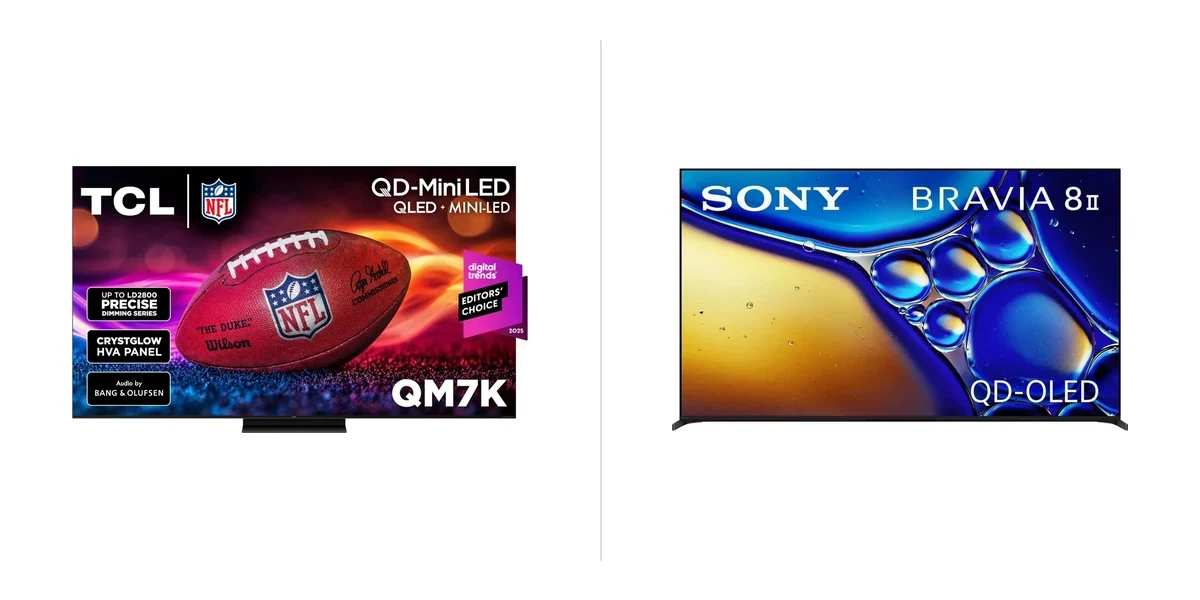
In the competitive 2026 TV market, the TCL QM7K and Sony Bravia 8 II OLED represent two distinct philosophies: aggressive value pricing with strong LED performance versus premium OLED refinement and audio innovation. The TCL delivers exceptional brightness and gaming features at a fraction of the cost, while the Sony focuses on reference-level accuracy, motion handling, and build quality. This head-to-head breaks down which television better suits different needs and budgets.
At a Glance
| Feature | TCL QM7K | Sony Bravia 8 II OLED |
|---|---|---|
| Price | $777.99 | $1999.0 |
| Overall Score | 89/100 | 88/100 |
| Best For | Value-driven gamers and bright-room viewing | Premium accuracy and design-focused buyers |
| Brightness & Contrast | Exceptional brightness and contrast for an LED TV in this price range | Peak brightness cannot match brightest mini-LED competitors |
| Gaming Performance | Outstanding 144Hz with full HDMI 2.1 support across all ports | Four HDMI 2.1 ports with full feature support |
| Audio Quality | Adequate (soundbar recommended) | Innovative Acoustic Surface Audio+ delivers immersive sound |
| Color Accuracy | Accurate colors and excellent factory calibration | Reference-level color accuracy and motion handling |
Design and Build
The TCL QM7K utilizes a plastic rear casing that feels less premium than competitors in the same segment. As a VA panel television, it also suffers from limited viewing angles, with color shift noticeable from side seats. These choices reflect its aggressive pricing strategy but may disappoint users seeking a more luxurious physical presence.
In contrast, the Sony Bravia 8 II OLED features premium build quality and a minimalist design that enhances any living space. Its central stand, while stable, requires a relatively deep surface and may not suit all furniture configurations. Overall, the Sony delivers a more refined aesthetic and construction that justifies its higher price point for buyers who value design as much as picture quality. Full review of the Sony Bravia 8 II OLED.
Performance and Features
The TCL QM7K stands out with exceptional brightness and contrast for an LED TV in this price range, paired with accurate colors and excellent factory calibration that requires minimal adjustment. Its outstanding 144Hz gaming performance, supported by full HDMI 2.1 across all ports, makes it a strong choice for console gamers. The Google TV platform is feature-packed and responsive with broad app support, though occasional minor interface stuttering can appear when multitasking with multiple 4K HDR streams. Some blooming is visible in high-contrast scenes despite advanced local dimming, and audio quality is merely adequate.
The Sony Bravia 8 II OLED excels with reference-level color accuracy and motion handling that outperforms most competitors, supported by the Cognitive Processor XR Gen 3 for exceptional upscaling. Its innovative Acoustic Surface Audio+ delivers immersive sound without requiring a soundbar for most users, and the four HDMI 2.1 ports provide excellent future-proofing for gamers. However, peak brightness, while improved, still cannot match the brightest mini-LED competitors in very bright living rooms. The Google TV interface continues to display occasional advertisements that some users find intrusive, and it lacks an integrated ATSC 3.0 tuner.
Our full review of TCL QM7K highlights how its gaming strengths and brightness help it compete despite the technology differences.
Pricing and Value
Priced at just $777.99, the TCL QM7K delivers an impressive value proposition that undercuts competitors by a significant margin. With an overall score of 89/100, it offers exceptional brightness, strong gaming performance, and accurate colors that punch well above its price class, making it accessible for budget-conscious buyers who still want modern features.
At $1999.0, the Sony Bravia 8 II OLED carries premium pricing that puts it out of reach for many enthusiasts who could be satisfied with slightly less expensive alternatives. While its 88/100 score reflects excellent reference performance and build quality, the substantial price gap means the TCL QM7K delivers significantly better overall value for the majority of consumers.
Pros and Cons
TCL QM7K
Pros:
– Exceptional brightness and contrast for an LED TV in this price range.
– Outstanding 144Hz gaming performance with full HDMI 2.1 support across all ports.
– Accurate colors and excellent factory calibration that requires minimal adjustment.
– Feature-packed Google TV platform with responsive performance and broad app support.
– Impressive value proposition that undercuts competitors by a significant margin.
Cons:
– Some blooming is visible in high-contrast scenes despite the advanced local dimming.
– Audio quality is merely adequate and most users will want to add a soundbar or AV system.
– Viewing angles are limited as expected from a VA panel, with color shift noticeable from side seats.
– The plastic rear casing feels less premium than competitors in the same segment.
– Occasional minor interface stuttering when multitasking with multiple 4K HDR streams.
Sony Bravia 8 II OLED
Pros:
– Reference-level color accuracy and motion handling that outperforms most competitors.
– Innovative Acoustic Surface Audio+ delivers immersive sound without requiring a soundbar for most users.
– Four HDMI 2.1 ports with full feature support make it exceptionally future-proof for gamers.
– Cognitive Processor XR Gen 3 provides exceptional upscaling of lower-resolution content.
– Premium build quality and minimalist design that enhance any living space.
Cons:
– Premium pricing puts it out of reach for many enthusiasts who could be satisfied with slightly less expensive alternatives.
– Peak brightness, while improved, still cannot match the brightest mini-LED competitors in very bright living rooms.
– Google TV interface continues to display occasional advertisements and content recommendations that some users find intrusive.
– The central stand, while stable, requires a relatively deep surface and may not suit all furniture configurations.
– Lack of integrated ATSC 3.0 tuner limits over-the-air broadcast capabilities in regions where this standard is prevalent.
Who Should Buy Which
Buy the TCL QM7K if you prioritize exceptional value, bright-room performance, and serious gaming capabilities without spending a fortune. It’s ideal for families, gamers, and enthusiasts who want accurate colors, 144Hz gameplay with full HDMI 2.1 support, and a responsive Google TV experience at an accessible price point.
Choose the Sony Bravia 8 II OLED if you value reference-level color accuracy, premium build quality, and immersive built-in audio that doesn’t require a soundbar. It suits dedicated home theater users and design-conscious buyers willing to invest more for superior motion handling and a minimalist aesthetic that elevates their living space.
Verdict
The TCL QM7K wins overall in this 2026 comparison with its higher 89/100 score and unmatched value at $777.99. It is the clear choice for gaming and bright-room performance where its exceptional brightness, 144Hz capabilities, and strong calibration deliver impressive results at a fraction of the cost.
The Sony Bravia 8 II OLED remains the better pick for users who prioritize reference-level accuracy, motion handling, and premium audio in controlled lighting. While excellent, its $1999.0 price makes the TCL QM7K the smarter purchase for most buyers seeking maximum performance per dollar.