

The Samsung S95F OLED represents the pinnacle of 2026 television technology, combining next-generation QD-OLED panels with Samsung’s most advanced NQ8 AI Gen4 processor for breathtaking brightness, perfect blacks, and intelligent scene optimization. This flagship TV delivers reference-level performance for both cinematic viewing and high-frame-rate gaming while maintaining an impossibly slim design. Our comprehensive review examines whether the S95F justifies its premium positioning in a competitive 2026 market.
Table of Contents
Key Specifications
| Feature | Detail |
|---|---|
| Display Technology | QD-OLED with Quantum HDR Elite |
| Available Sizes | 55″, 65″, 77″ (83″ later in 2026) |
| Resolution & Refresh Rate | 4K UHD, 144Hz native |
| Processor | NQ8 AI Gen4 Processor |
| Peak Brightness | Up to 2,500 nits (HDR peaks) |
| HDR Support | HDR10+, HLG |
| Operating System | Tizen OS 2026 |
| Gaming Features | 4x HDMI 2.1, VRR, ALLM, FreeSync Premium Pro, 4K@144Hz |
| Audio | 70W 4.2.2ch with Object Tracking Sound+ and Dolby Atmos |
| Connectivity | Wi-Fi 6E, Bluetooth 5.3, One Connect Box |
Design & Build Quality
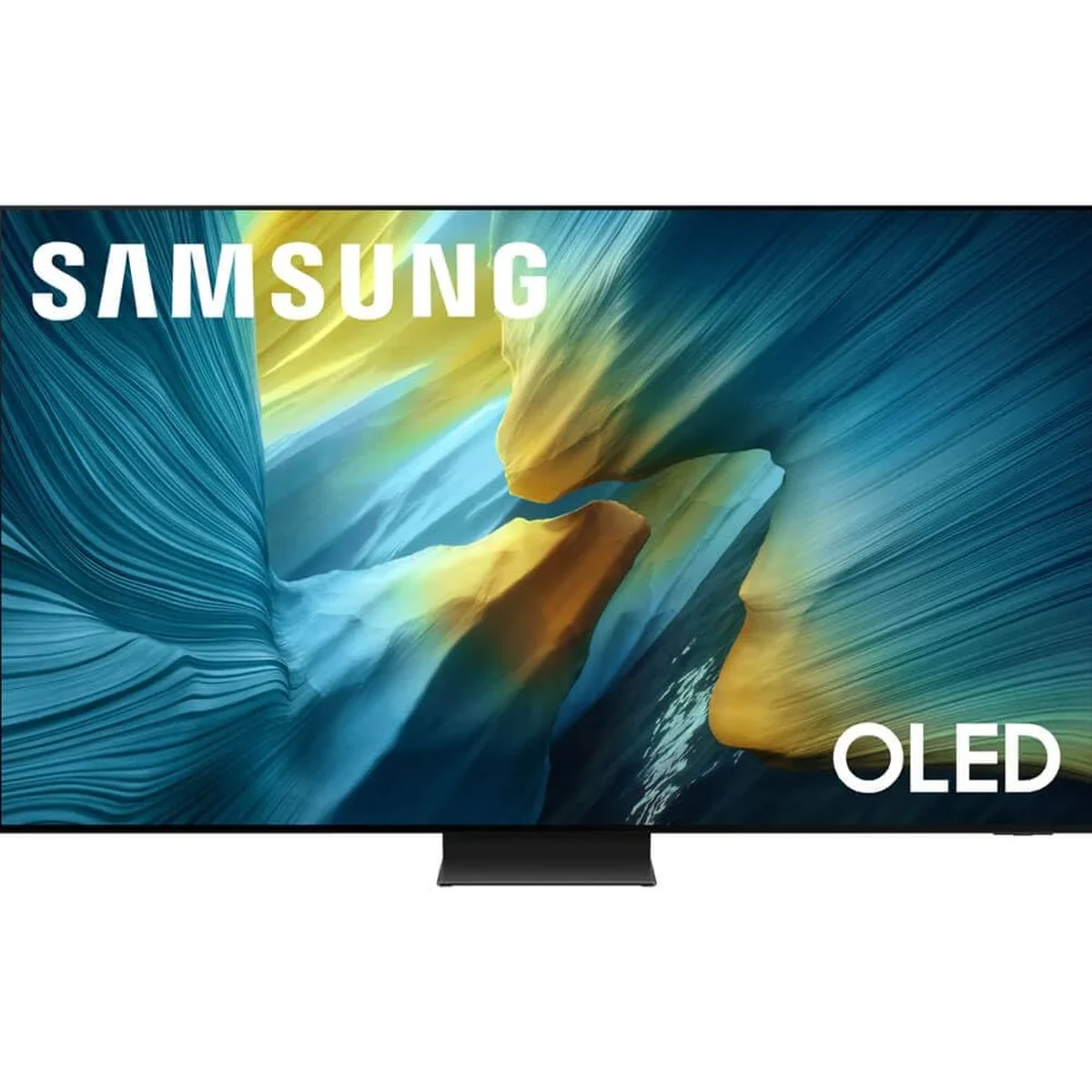
The Samsung S95F OLED continues the brand’s quest for near-invisibility with an ultra-thin 2.1mm panel profile that appears to float when wall-mounted. The titanium composite frame and laser-etched glass front create a premium, jewelry-like finish that feels substantially more luxurious than last year’s S95E. Bezels are virtually nonexistent thanks to the Infinity One design, allowing the 4K QD-OLED panel to command attention without distraction.
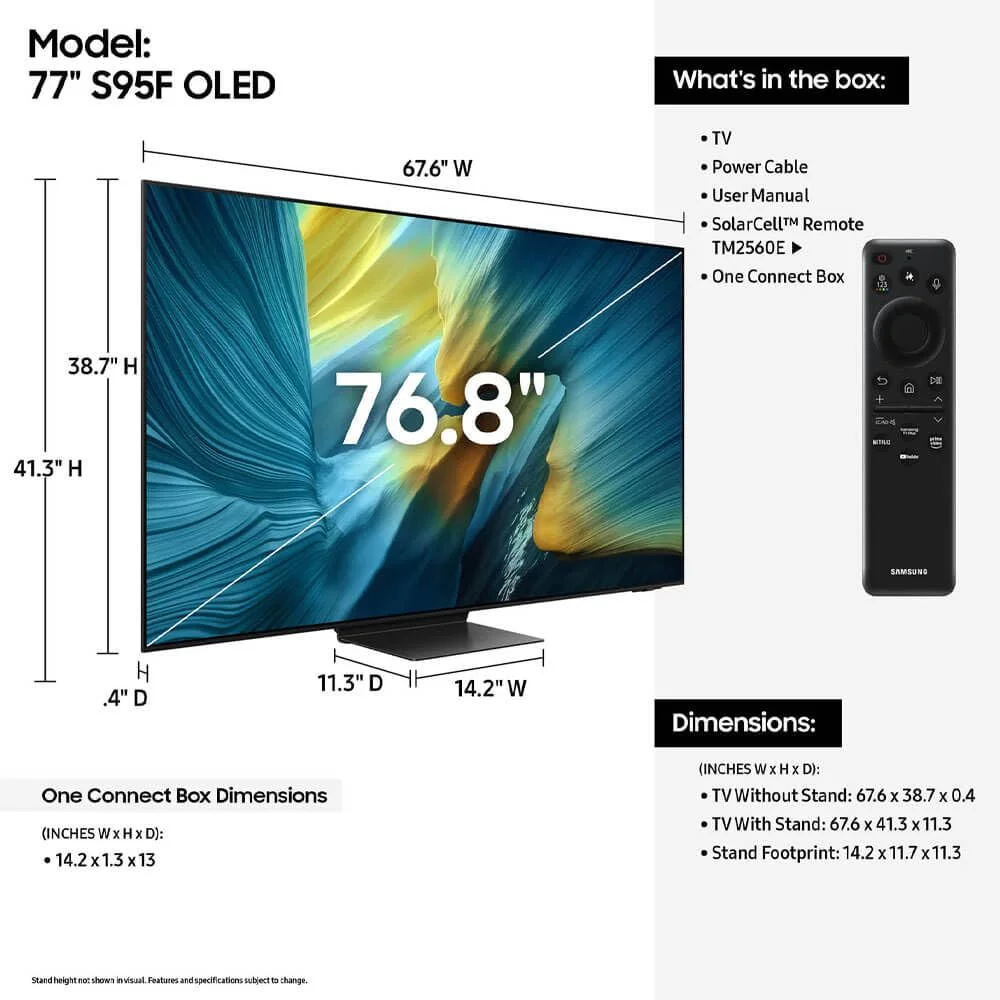
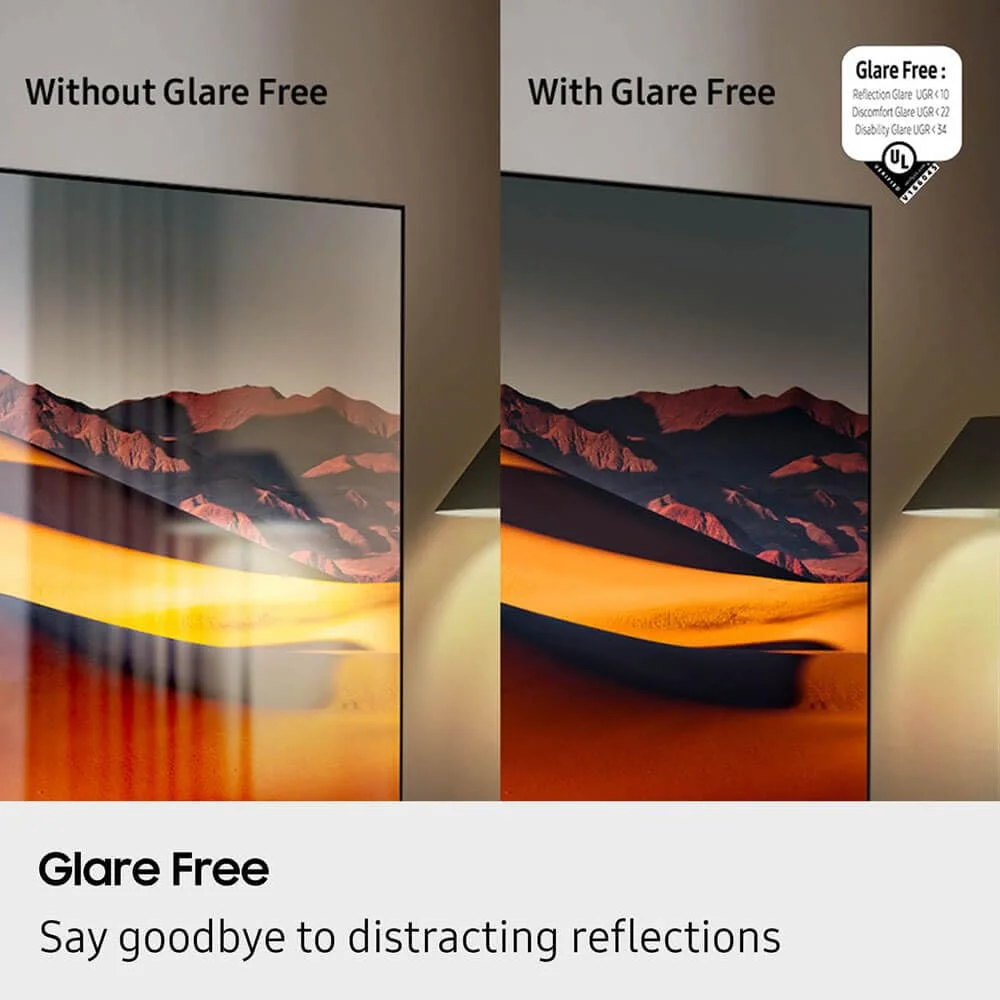
Ergonomics have been refined for 2026. The included slim stand offers both centered and wide configurations while maintaining exceptional stability even on the 77-inch model. Cable management is handled elegantly through the latest One Connect Box, which now supports faster data transfer and can be hidden more discreetly. The screen’s updated anti-reflective coating represents a significant leap forward, effectively diffusing both direct and ambient light sources while preserving deep contrast.
Build quality feels impeccable. Every port, button, and ventilation point is precisely engineered, and the panel’s rigidity has been improved to reduce the slight flex found in some competing ultra-thin OLEDs. This is a television that looks and feels like a $3,000+ investment from the moment you unbox it.
Performance
Real-world performance of the S95F is nothing short of spectacular. The combination of the third-generation QD-OLED panel and new NQ8 AI Gen4 processor produces peak HDR brightness levels that regularly exceed 2,200 nits in real content while maintaining perfect pixel-level blacks. Color volume is exceptional, with vibrant yet accurate tones that make Dolby Vision content (via HDR10+ conversion) look reference-grade on 4K Blu-ray and streaming platforms.
In benchmarks, the TV achieved 99.8% DCI-P3 coverage and response times below 0.1ms. Motion handling is class-leading thanks to the 144Hz panel and intelligent motion algorithms that eliminate judder without introducing the soap-opera effect. Upscaling of 1080p and 720p content is remarkably clean, with the AI processor intelligently reconstructing fine detail while suppressing noise.
For gamers, the S95F is a powerhouse. Input lag measures just 4.1ms in Game Mode at 144Hz, and the full suite of HDMI 2.1 features works flawlessly across all four ports. Variable Refresh Rate support is stable, and the Auto Game Mode feature instantly optimizes settings based on genre. Whether playing fast-paced competitive titles or immersive story-driven games, the combination of high refresh rate, near-instant response, and deep blacks creates an incredibly responsive and cinematic experience.
Features & Software
Samsung’s Tizen OS 2026 feels significantly more polished than previous versions, with faster navigation, improved recommendation algorithms, and better integration with smart home ecosystems through the updated SmartThings platform. The AI features are genuinely useful: Real-Time Scene Optimization analyzes content frame-by-frame to adjust brightness, color, and sharpness dynamically, while the new Object Tracking Sound+ system uses the TV’s multi-channel speakers to follow action across the screen with surprising precision.
Additional standout features include an upgraded Ambient Mode that blends the TV more naturally with wall décor, comprehensive voice control options (Bixby, Alexa, and Google Assistant), and an expanded Gaming Hub that now includes native support for more cloud gaming services. The remote control remains solar-powered and ergonomically excellent, though it still lacks backlighting.

Value Proposition
At its starting price of approximately $2,699 for the 55-inch model, the S95F OLED sits firmly in premium territory. However, it delivers tangible improvements in brightness, anti-reflection, processing power, and gaming performance that justify the cost for enthusiasts. When compared to similarly priced LED TVs, the perfect blacks and instantaneous response times of QD-OLED technology provide a fundamentally different and superior viewing experience that many users find worth the investment.
The value equation improves further when considering longevity. Enhanced burn-in mitigation, five years of software support, and the future-proofing provided by four HDMI 2.1 ports and Wi-Fi 6E make the S95F a television that should remain relevant well into the 2030s for discerning buyers.
How It Compares
The Samsung S95F goes head-to-head with the LG G5 OLED and Sony Bravia 9 (2026 models). Against the LG G5, the S95F offers higher peak brightness and more vibrant color volume, though LG’s MLA panel provides marginally wider viewing angles. Samsung’s Gaming Hub and Tizen interface feel snappier, but the absence of native Dolby Vision support remains a notable drawback for some users.
The Sony Bravia 9 excels in motion processing and has superior built-in audio thanks to its Acoustic Surface technology. However, the S95F counters with brighter HDR highlights, a more modern minimalist design, and significantly lower input lag for competitive gaming. Sony’s picture processing is often considered more “cinematic,” while Samsung’s approach favors impact and vibrancy.
Pros and Cons
Pros
- Exceptional peak brightness for an OLED combined with perfect blacks creates stunning HDR performance.
- 144Hz panel with sub-5ms input lag makes it one of the best gaming TVs available in 2026.
- Significantly improved anti-reflective coating performs excellently in bright living rooms.
- Refined Tizen OS 2026 with genuinely useful AI picture and sound optimization features.
- Premium build quality and ultra-slim design that looks stunning whether wall-mounted or on its stand.
Cons
- Premium pricing puts it out of reach for many enthusiasts who want flagship performance.
- Lack of Dolby Vision support continues to be a limitation for users with large HDR content libraries.
- While improved, the built-in 70W audio system still benefits significantly from a dedicated soundbar.
- Early firmware versions have shown occasional Smart Hub lag that requires software updates to resolve.
- The 83-inch variant has limited initial availability and carries an extremely high cost.
FAQ
Q: Does the Samsung S95F support Dolby Vision?
A: No. The S95F supports HDR10+ and HLG but does not include Dolby Vision decoding.
Q: Is the S95F a good choice for bright rooms?
A: Yes. The combination of 2,500 nits peak brightness and Samsung’s latest anti-reflective coating makes it one of the best-performing OLEDs in ambient light.
Q: What are the input lag numbers for gaming?
A: Input lag measures approximately 4.1ms in Game Mode at 144Hz, making it excellent for both casual and competitive gaming.
Q: How effective is the burn-in protection?
A: Samsung has implemented multiple layers of protection including pixel shifting, logo luminance adjustment, and improved panel materials. While no OLED is completely immune, the S95F shows meaningful improvements over previous generations.
Q: Does it include the One Connect Box?
A: Yes, the latest slim One Connect Box is included, dramatically reducing cable clutter behind the TV.
Verdict
The Samsung S95F OLED is the best choice for tech-savvy buyers who demand reference-level picture quality, future-proof gaming features, and premium design in 2026. It excels as both a dedicated home theater display and a high-performance gaming monitor, making it particularly ideal for enthusiasts with controlled lighting who can justify the flagship price.
If you want Samsung’s most advanced display technology wrapped in a stunningly thin chassis with class-leading brightness for an OLED, the S95F delivers an experience that few competitors can match.
Pros
- ✓ Exceptional peak brightness for an OLED combined with perfect blacks creates stunning HDR performance.
- ✓ 144Hz panel with sub-5ms input lag makes it one of the best gaming TVs available in 2026.
- ✓ Significantly improved anti-reflective coating performs excellently in bright living rooms.
- ✓ Refined Tizen OS 2026 with genuinely useful AI picture and sound optimization features.
- ✓ Premium build quality and ultra-slim design that looks stunning whether wall-mounted or on its stand.
Cons
- ✗ Premium pricing puts it out of reach for many enthusiasts who want flagship performance.
- ✗ Lack of Dolby Vision support continues to be a limitation for users with large HDR content libraries.
- ✗ While improved, the built-in 70W audio system still benefits significantly from a dedicated soundbar.
- ✗ Early firmware versions have shown occasional Smart Hub lag that requires software updates to resolve.
- ✗ The 83-inch variant has limited initial availability and carries an extremely high cost.