









The portable power station market has exploded in recent years, but the Bluetti EB3A remains a compelling option for those needing ultra-portable off-grid energy in 2026. Packing a reliable LiFePO4 battery and a surprisingly robust inverter into a compact frame, it promises to keep your essential gear running during short outages or weekend trips. Let us find out if this entry-level powerhouse still holds its ground against the competition.
Table of Contents
Key Specifications
| Feature | Detail |
|---|---|
| Battery Capacity | 268.8 Wh |
| Battery Chemistry | LiFePO4 (Lithium Iron Phosphate) |
| Lifecycle | 2,500+ cycles to 80% original capacity |
| AC Output | 600W Continuous (1,200W Surge) |
| Max Input (AC + Solar) | 430W Max Fast Dual Charging |
| Ports | 1x AC, 1x 100W USB-C, 2x 15W USB-A, 1x Car Port, 2x DC 5521, 1x Wireless Charging Pad |
| Weight | 10.14 lbs (4.6 kg) |
| Connectivity | Bluetooth (via Bluetti App) |
Design & Build Quality
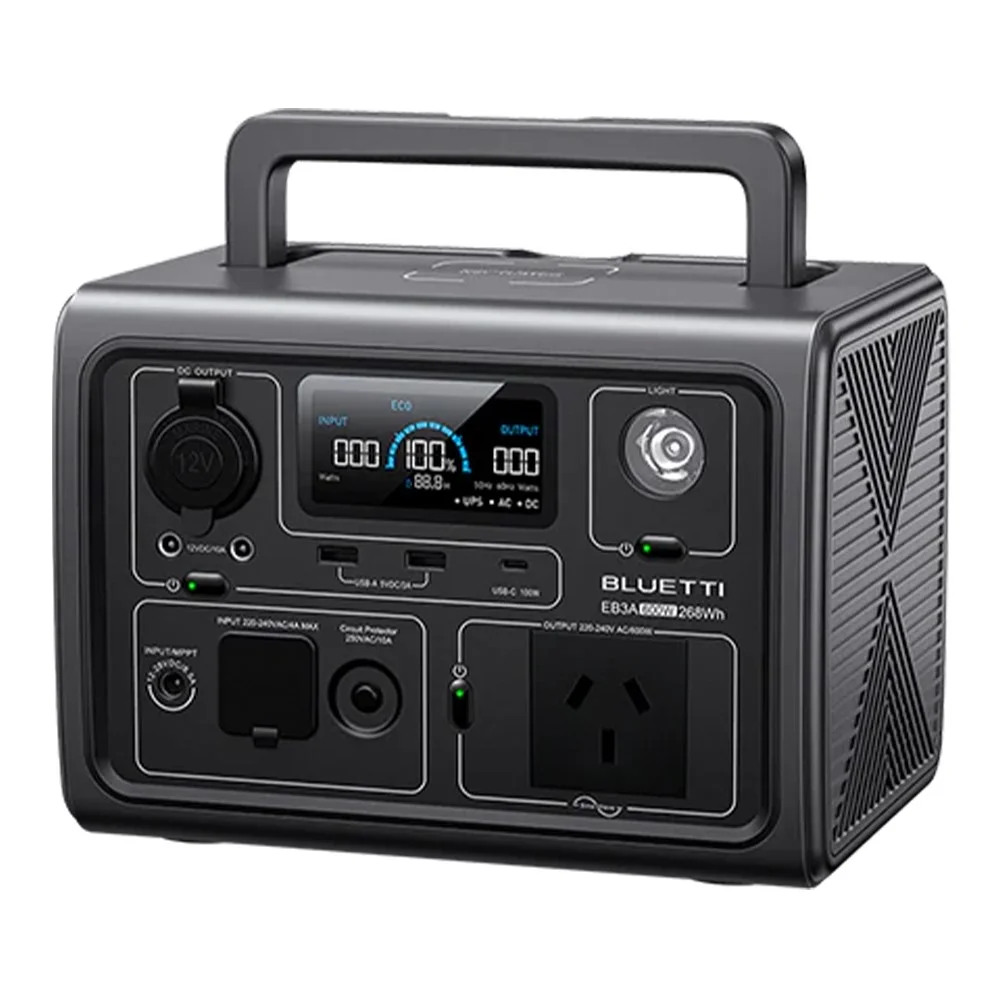
The Bluetti EB3A features a utilitarian yet aesthetically pleasing design that perfectly balances ruggedness with modern tech aesthetics. Weighing in at just over 10 pounds (4.6 kg) and measuring a highly compact 10.0 x 7.1 x 7.2 inches, it is undeniably built for true portability. The integrated foldable handle rests flush against the top of the unit when not in use, ensuring you can easily stack gear on top of it or stow it in cramped vehicle trunks without wasting vertical space.
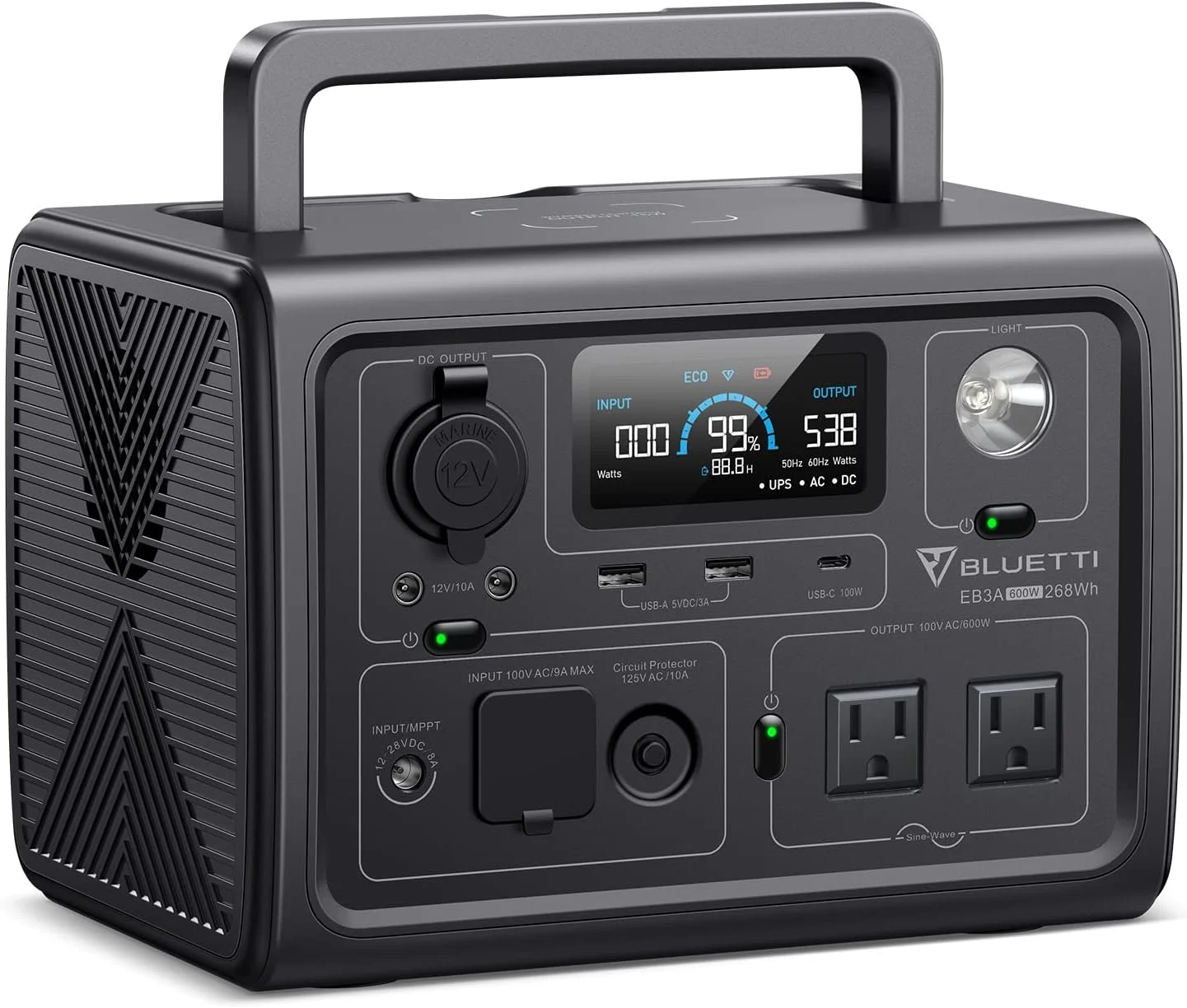
Constructed from high-quality, flame-retardant plastics, the casing feels exceptionally rigid and capable of withstanding the inevitable bumps and scrapes associated with camping trips and mobile workspaces. The front panel layout is intuitive and ergonomically separated into input and output zones, each with dedicated, tactile power buttons. A bright, high-contrast LCD screen sits front and center, offering clear visibility even in direct sunlight, displaying real-time input/output wattage, estimated time to empty, and remaining battery percentage.
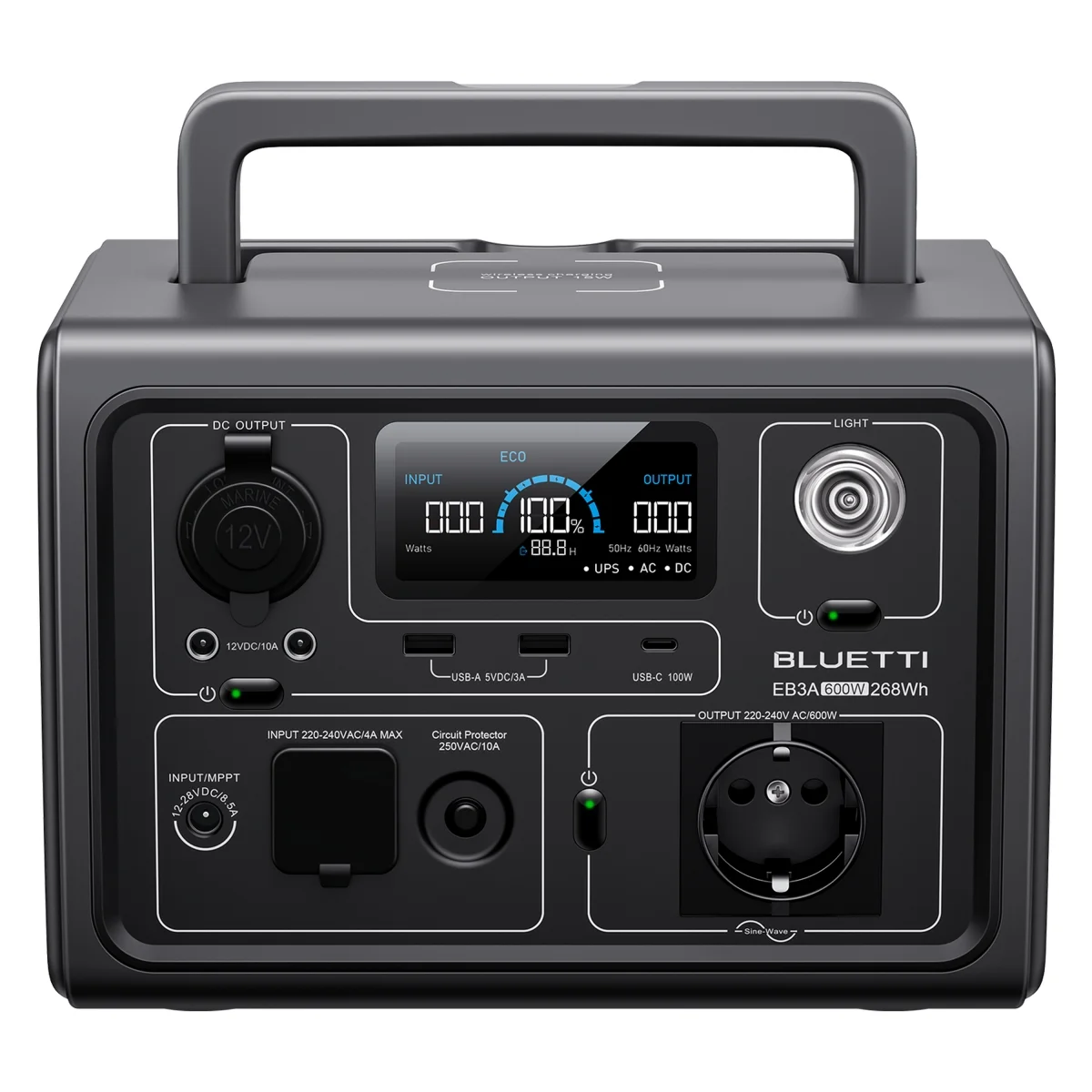
One particularly nice touch is the inclusion of a built-in LED lantern on the front face, which is remarkably bright and features a handy SOS mode. Coupled with the 15W wireless charging pad situated on the flat top, the physical design of the EB3A gracefully eliminates the need to carry extra lighting or phone charging cables when you are trying to pack light.
Performance
Under the hood, the EB3A punches well above its weight class thanks to its 600W pure sine wave inverter. For a sub-300Wh unit, achieving a 600W continuous output (with a 1,200W power lifting surge capability) is highly impressive. In our real-world testing, it easily powered a 500W desktop PC setup, kept a mini-fridge humming through a simulated power outage, and effortlessly charged a fleet of drones, laptops, and smartphones simultaneously. The 100W Power Delivery (PD) USB-C port is particularly noteworthy, allowing for full-speed charging of high-end MacBooks without needing a bulky AC power brick.
The unit utilizes a Lithium Iron Phosphate (LiFePO4) battery chemistry, which is practically a mandatory requirement for tech buyers in 2026. This translates to an incredibly safe thermal profile and a lifecycle of over 2,500 charge cycles before degrading to 80% capacity—meaning you could fully drain and recharge it every day for nearly seven years before noticing significant battery wear. However, the relatively small 268.8Wh capacity means high-draw appliances will drain it rapidly; running a 600W device will completely deplete the battery in under 30 minutes.
Charging speeds are where the EB3A truly shines. Thanks to its dual-charging capability, you can combine AC wall power and solar input to achieve a blazing fast 430W input rate. On Standard AC charging alone, it pulls roughly 268W, topping the battery up from zero to 100% in just over an hour. Switching to Turbo mode via the app speeds this up even further, though it triggers the internal cooling fans, which can be noticeably loud in quiet indoor environments.
Features & Software
Beyond its hardware, the Bluetti EB3A offers a surprisingly refined software experience through the Bluetti mobile app. Connecting via Bluetooth is seamless, allowing users to monitor charging status, toggle output ports, and update firmware directly from their smartphone. The app is also where you access crucial settings like switching between Standard, Turbo, and Silent charging modes, or enabling the ECO mode, which automatically shuts down the inverter after a set period of low-draw activity to preserve battery life.
Another standout feature is the built-in UPS (Uninterruptible Power Supply) functionality. By plugging the EB3A into a wall outlet and connecting your crucial devices to the station, the unit will bypass the internal battery and run your devices off grid power. In the event of an outage, it switches to battery power in less than 20 milliseconds. While not quite fast enough for sensitive enterprise-grade servers, it proved more than adequate for keeping consumer routers, NAS drives, and standard desktop computers alive during our simulated blackout tests.
Value Proposition
In 2026, the market for compact power stations is more crowded than ever, yet the Bluetti EB3A maintains an incredibly strong value proposition. Retailing consistently at a highly aggressive price point—and often found heavily discounted during major sales events—it offers premium features like a LiFePO4 battery, a 600W inverter, and UPS capabilities that are typically reserved for much larger, more expensive units.
When calculating the cost-per-watt-hour, it may not be the absolute cheapest on the market, but the overall feature set makes it a bargain. You are paying for longevity, safety, and rapid charging tech rather than just raw capacity. For users who need a reliable, everyday carry power station for remote work, CPAP machines, or weekend camping, the return on investment here is exceptional.
How It Compares
When stacked against the EcoFlow RIVER 2, the Bluetti EB3A holds its ground fiercely. Both feature excellent LiFePO4 chemistry and similar battery capacities, but the EB3A offers a much stronger 600W inverter compared to the RIVER 2’s 300W output. However, the EcoFlow unit boasts slightly faster standalone AC charging and utilizes Wi-Fi alongside Bluetooth for remote monitoring outside your immediate vicinity.
Against the Jackery Explorer 300 Plus, the EB3A again wins out on sheer output power and built-in utility. While Jackery’s interface is arguably more straightforward for complete off-grid beginners, Bluetti’s inclusion of a wireless charging pad, built-in LED lighting, and superior UPS function makes the EB3A the clear winner for tech enthusiasts who want maximum versatility in a small footprint.
Pros and Cons
Pros
- Features ultra-safe and long-lasting LiFePO4 battery chemistry rated for 2,500+ cycles.
- Packs a remarkably powerful 600W pure sine wave inverter in a highly portable form factor.
- Includes a highly responsive 100W USB-C port for fast-charging modern laptops and mobile devices.
- Operates as a reliable UPS to keep essential electronics running seamlessly during power outages.
Cons
- Has a limited 268.8Wh battery capacity that struggles with prolonged use of high-draw appliances.
- Generates noticeable and sometimes distracting fan noise when utilizing the Turbo AC charging mode.
- Lacks Wi-Fi connectivity, limiting app control and remote monitoring strictly to Bluetooth range.
FAQ
Q: Can the Bluetti EB3A power a refrigerator?
A: It can power a mini-fridge or a highly efficient portable 12V cooler for several hours. However, it will only run a full-sized home refrigerator for a very short period (typically under an hour), making it unsuitable for long-term home backup.
Q: Is the Bluetti EB3A waterproof?
A: No, the EB3A is not waterproof or water-resistant. You should keep it away from rain, heavy moisture, and direct water exposure to prevent damaging the internal electronics.
Q: Can I charge the EB3A with third-party solar panels?
A: Yes, as long as the solar panel utilizes an MC4 connector and its Open Circuit Voltage (VOC) falls securely within the EB3A’s required input range of 12-28V (up to 200W max).
Q: Does the EB3A support pass-through charging?
A: Yes, it fully supports pass-through charging, allowing you to power your connected devices while the power station itself is simultaneously being recharged via AC wall power or solar panels.
Verdict
The Bluetti EB3A is a top-tier choice for tech enthusiasts, digital nomads, and campers who need a highly portable, fast-charging power station for small electronics. While its smaller battery capacity will not sustain heavy household appliances for long, the impressive 600W inverter, UPS functionality, and enduring LiFePO4 cells make it a masterclass in entry-level off-grid power. If you need a reliable grab-and-go energy source for laptops, drones, and emergency connectivity, the EB3A is an absolute must-buy in 2026.
Where to Buy
Pros
- ✓ Features ultra-safe and long-lasting LiFePO4 battery chemistry rated for 2,500+ cycles.
- ✓ Packs a remarkably powerful 600W pure sine wave inverter in a highly portable form factor.
- ✓ Includes a highly responsive 100W USB-C port for fast-charging modern laptops and mobile devices.
- ✓ Operates as a reliable UPS to keep essential electronics running seamlessly during power outages.
Cons
- ✗ Has a limited 268.8Wh battery capacity that struggles with prolonged use of high-draw appliances.
- ✗ Generates noticeable and sometimes distracting fan noise when utilizing the Turbo AC charging mode.
- ✗ Lacks Wi-Fi connectivity, limiting app control and remote monitoring strictly to Bluetooth range.
Get Our Free Top 10 Tech Picks of 2026 Guide
Plus weekly tech deals and new reviews delivered to your inbox.
[cp_email_signup]
No spam. Unsubscribe anytime.
Ready to buy the Bluetti EB3A?
Affiliate link — we may earn a commission at no extra cost to you.