




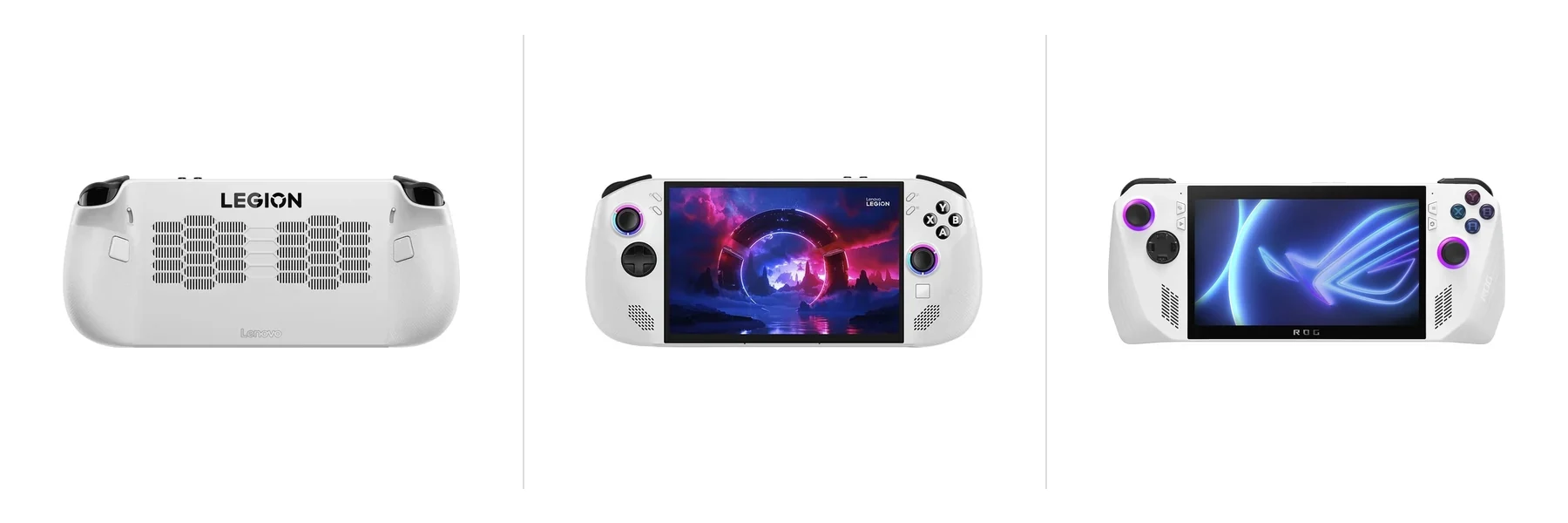
In 2026, Lenovo’s refreshed Legion Go S lineup battles ASUS’s established ROG Ally Z1 Extreme in the premium Windows gaming handheld space. The Legion Go S Z2 Go brings next-gen AMD power and a high-refresh display in a more accessible package, while the standard Legion Go S doubles down on premium materials and screen quality at a much higher cost. This comparison breaks down which device delivers the best real-world experience for portable PC gaming.
At a Glance
| Feature | Lenovo Legion Go S Z2 Go | Lenovo Legion Go S | ASUS ROG Ally Z1 Extreme |
|---|---|---|---|
| Price | $839.99 | $1472.35 | $639.97 |
| Overall Score | 83/100 | 83/100 | 81/100 |
| Best For | Future-proofed high-performance gaming | Premium display and build seekers | Value-focused exceptional performance |
| Display | Beautiful 8.8-inch 180Hz QHD+ | 8.8-inch 2560×1600 165Hz with vibrant colors | 120Hz VRR with excellent color reproduction |
| Ergonomics | Significantly improved with detachable controllers | Significantly improved with Hall Effect controls | Hall-effect joysticks for reliability and comfort |
| Battery Life | Limited to 2-3 hours under load | Drops significantly with demanding titles | 90-120 minutes in intensive sessions |
Design and Build
All three devices emphasize premium build quality and improved ergonomics over earlier handheld efforts. The Lenovo Legion Go S Z2 Go and Lenovo Legion Go S both deliver significantly improved ergonomics, with the former adding versatile detachable controllers and FPS mode functionality while the latter incorporates Hall Effect controls and thoughtful premium materials. The ASUS ROG Ally Z1 Extreme matches this focus on long-term reliability through Hall-effect joysticks and solid construction that feels comfortable for extended sessions.
Despite these upgrades, portability remains a shared challenge. Both Lenovo models are still relatively heavy, which can cause fatigue during prolonged handheld play, while the ROG Ally Z1 Extreme tends to become uncomfortably warm under load. All three feel like premium devices but require some compromise on true pocketable portability.
Performance and Features
The Lenovo Legion Go S Z2 Go delivers exceptional gaming performance powered by the AMD Ryzen Z2 Extreme and 32GB RAM, while the Lenovo Legion Go S offers excellent real-world gaming performance with its AMD Ryzen AI processor and identical 32GB RAM configuration. The ASUS ROG Ally Z1 Extreme stands out by outperforming most competing handhelds in demanding titles. Each device provides a high-quality display—the Z2 Go’s beautiful 8.8-inch 180Hz QHD+ panel, the Legion Go S’s class-leading 8.8-inch 2560×1600 165Hz screen with vibrant colors, and the Ally’s responsive 120Hz VRR display with excellent color reproduction.
Feature sets lean heavily on Windows 11 flexibility, giving all three access to virtually any PC game or application. The Legion Go S Z2 Go provides strong future-proofing with USB4, Wi-Fi 7, and PCIe 5.0 storage (full review), and the ROG Ally Z1 Extreme counters with excellent expandability through USB4, XG Mobile eGPU support, and M.2 SSD upgrades (full review). The Legion Go S impresses with strong overall build and display quality (full review) but shares the Windows 11 drawbacks of required manual configuration, workarounds, and imperfect software overlays that affect all three devices.
Battery life is a consistent weakness. The Legion Go S Z2 Go lasts 2-3 hours under demanding workloads, the Legion Go S sees significant drops at higher TDP settings, and the ROG Ally Z1 Extreme often manages only 90-120 minutes during intensive AAA sessions. Fan noise under load is another shared trait, becoming noticeably loud on the Legion Go S and ROG Ally.
Pricing and Value
The ASUS ROG Ally Z1 Extreme at $639.97 delivers the strongest value proposition, offering exceptional gaming performance and expandability at a notably lower price than its rivals. The Lenovo Legion Go S Z2 Go at $839.99 represents a sensible middle ground—providing comparable overall performance and superior future-proofing without the extreme cost of the standard Legion Go S.
At $1472.35, the Lenovo Legion Go S struggles to justify its premium over the Z2 Go given the identical 83/100 score and similar real-world drawbacks around battery life and Windows navigation. For most buyers the ROG Ally Z1 Extreme or Legion Go S Z2 Go will deliver better value depending on whether budget or cutting-edge features matter more.
Pros and Cons
Lenovo Legion Go S Z2 Go
Pros:
– Exceptional gaming performance powered by the AMD Ryzen Z2 Extreme and 32GB RAM.
– Beautiful 8.8-inch 180Hz QHD+ display delivers smooth and sharp visuals.
– Significantly improved ergonomics and build quality over the original Legion Go.
– Versatile detachable controllers with useful FPS mode functionality.
– Strong future-proofing with USB4, Wi-Fi 7, and PCIe 5.0 storage.
Cons:
– Battery life remains limited to 2-3 hours under demanding gaming workloads.
– The device is still relatively heavy for true pocketable portability.
– Windows 11 interface requires more manual configuration than dedicated handheld OS options.
– Premium price point may be too high for casual gamers.
– Occasional minor bugs persist in the Legion Space 2.0 software overlay.
Lenovo Legion Go S
Pros:
– Delivers excellent real-world gaming performance with its powerful AMD Ryzen AI processor and 32GB RAM configuration.
– The 8.8-inch 2560×1600 165Hz display is one of the best in the handheld category with vibrant colors and smooth motion.
– Significantly improved ergonomics and Hall Effect controls make it comfortable for long gaming sessions.
– Versatile Windows 11 experience allows access to virtually any PC game or application.
– Strong build quality with premium materials and thoughtful design details throughout.
Cons:
– The device is still relatively heavy at 795g, which can cause fatigue during extended handheld use.
– Fan noise becomes noticeably loud under heavy gaming loads despite the improved cooling system.
– Windows 11 interface still requires occasional workarounds for optimal handheld navigation.
– Battery life drops significantly when running demanding titles at higher TDP settings.
– The Legion Space software, while improved, still lacks the seamless integration found in console ecosystems.
ASUS ROG Ally Z1 Extreme
Pros:
– Delivers exceptional gaming performance that outperforms most competing handhelds in demanding titles.
– The 120Hz VRR display provides incredibly smooth and responsive visuals with excellent color reproduction.
– Full Windows 11 operating system grants access to every PC game store and application available.
– Hall-effect joysticks and premium build quality ensure long-term reliability and comfort.
– Excellent expandability through USB4, XG Mobile eGPU support, and M.2 SSD upgrades.
Cons:
– Battery life remains limited, often dropping to 90-120 minutes during intensive AAA gaming sessions.
– The device can become uncomfortably warm during extended high-performance use.
– Fan noise is noticeable under load, which may disturb quiet environments or immersive gameplay.
– Windows 11 still requires manual tweaks and third-party software for optimal handheld controller navigation.
– Premium pricing positions it above more affordable alternatives for casual gamers.
Who Should Buy Which
Lenovo Legion Go S Z2 Go suits gamers who want top-tier AMD performance, a high-refresh-rate display, and future-proof connectivity without spending over $1,400. Its detachable controllers and improved ergonomics make it a strong choice for users who value versatility and sharp visuals during longer play sessions, provided they can plan around 2-3 hours of battery life.
Lenovo Legion Go S fits enthusiasts willing to pay a premium for what many consider one of the best handheld displays available, paired with refined ergonomics and premium materials. It’s ideal for those who prioritize screen quality and build details above all else and don’t mind louder fans or the high $1472.35 price tag.
ASUS ROG Ally Z1 Extreme is the pick for gamers seeking exceptional performance and full PC flexibility at the lowest cost of the three. Its strong expandability options and reliable Hall-effect controls make it attractive for value-conscious buyers who accept shorter battery sessions and some heat in exchange for significant savings.
Verdict
The Lenovo Legion Go S Z2 Go wins overall in 2026 by delivering an 83/100 experience with exceptional performance, a excellent 180Hz display, and meaningful future-proofing at $839.99. It strikes the best balance between capability and cost, especially compared to the significantly more expensive Legion Go S that offers no meaningful score advantage. The ASUS ROG Ally Z1 Extreme remains a strong runner-up for buyers prioritizing value at $639.97, making it the clear recommendation when budget is the deciding factor.