

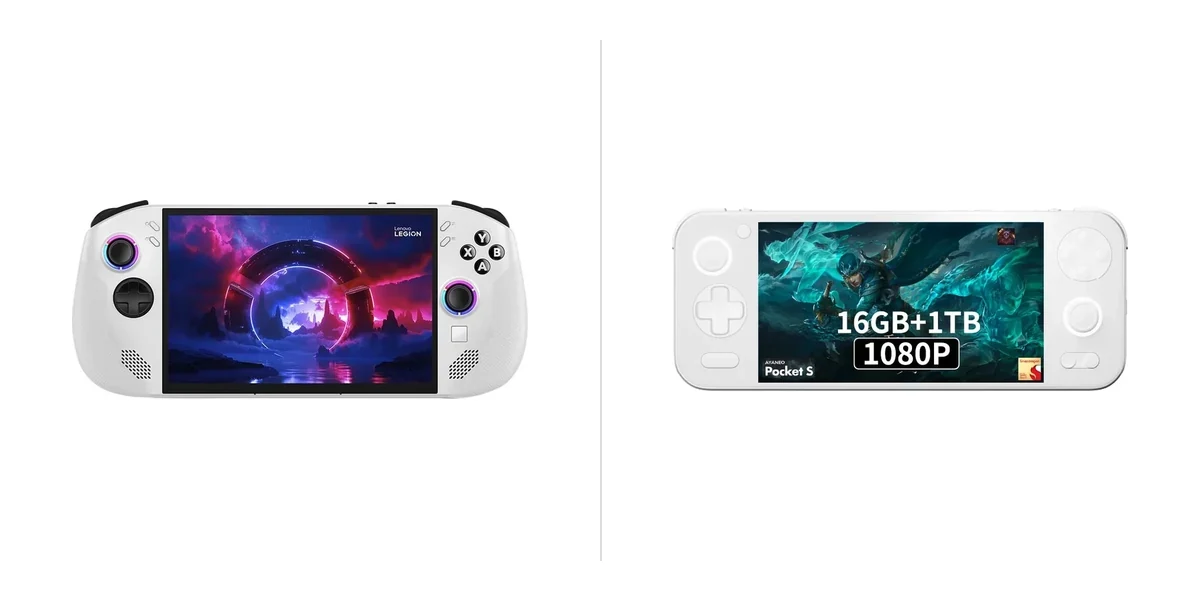
In 2026, the Lenovo Legion Go and AYANEO Pocket S represent two distinct approaches to Windows gaming handhelds. The Legion Go delivers a large-screen, modular experience with detachable controllers, while the Pocket S emphasizes true pocketability and refined portability. This matchup examines how their differing designs and capabilities suit various portable gaming lifestyles.
At a Glance
| Feature | Lenovo Legion Go | AYANEO Pocket S |
|---|---|---|
| Price | $1472.35 | $519.99 |
| Overall Score | 80/100 | 77/100 |
| Best For | Immersive versatile gaming | Pocketable performance and emulation |
| Display | 8.8-inch 144Hz QHD+ touchscreen | 165Hz AMOLED |
| Controls | Detachable with FPS mouse support | Hall-effect with thoughtful ergonomics |
| Portability | 854g, fatiguing for long sessions | Truly pocketable and lightweight |
| Battery Life | 2-2.5 hours demanding games | Limited in high-performance sessions |
Design and Build
The Lenovo Legion Go adopts a larger form factor built around its expansive 8.8-inch touchscreen and innovative detachable controllers. This design enables exceptional versatility for traditional gaming, tabletop mode, and FPS mouse controls while maintaining solid build quality and support for expandable M.2 storage. However, its 854g weight becomes fatiguing during extended handheld sessions compared to lighter competitors.
In contrast, the AYANEO Pocket S prioritizes truly pocketable dimensions and lightweight construction, making it ideal for everyday carry. It features premium build quality with Hall-effect controls and thoughtful ergonomics that enhance comfort. While both devices feel well-made, the Pocket S focuses on compact refinement whereas the Legion Go emphasizes modular functionality at the cost of added bulk.
Performance and Features
The Lenovo Legion Go leverages its AMD Ryzen Z1 Extreme processor combined with 16GB RAM to deliver strong performance for modern AAA titles and multitasking. Its expansive 8.8-inch 144Hz QHD+ touchscreen provides immersive visuals that make other handhelds feel limited, and the full Windows 11 experience ensures complete compatibility with all PC games, software, and peripherals. However, fan noise becomes quite noticeable under load and the Windows 11 interface feels clunky for touch navigation without tweaks or controllers attached. Our full review of Lenovo Legion Go explores these capabilities in depth.
The AYANEO Pocket S matches strong performance across both modern AAA titles and extensive emulation libraries, powered by its stunning 165Hz AMOLED display that delivers vibrant colors and smooth gameplay. Flexible TDP modes and a capable software overlay further enhance the user experience alongside its premium Hall-effect controls. That said, the device can become uncomfortably warm during prolonged high-TDP gameplay and still requires occasional Windows 11 tweaks for optimal handheld use. Our full review of AYANEO Pocket S details its portable strengths.
Both devices suffer from limited battery life during demanding sessions, with the Legion Go typically lasting only 2-2.5 hours and the Pocket S struggling in high-performance 1080p gaming. Speaker volume on the Pocket S, while improved, still lacks the impact of larger handhelds.
Pricing and Value
Priced at $1472.35, the Lenovo Legion Go sits at a premium point that reflects its large display, versatile detachable controllers, and strong feature set. However, its disappointing battery life, noticeable fan noise, and high cost may not appeal to gamers seeking maximum value on a tighter budget.
At $519.99, the AYANEO Pocket S delivers significantly better value for users who prioritize portability. While the review still notes its premium pricing positions it beyond many casual gamers, the much lower cost combined with pocketable design, vibrant AMOLED display, and capable performance makes it the clearer value proposition for everyday portable gaming compared to the nearly three-times-more-expensive Legion Go.
Pros and Cons
Lenovo Legion Go
Pros:
– The expansive 8.8-inch 144Hz QHD+ touchscreen delivers immersive visuals that make other handhelds feel limited by comparison.
– Detachable controllers provide exceptional versatility, supporting traditional gaming, tabletop mode, and innovative FPS mouse controls.
– AMD Ryzen Z1 Extreme processor combined with 16GB RAM offers strong performance for modern AAA titles and multitasking.
– Full Windows 11 experience ensures complete compatibility with all PC games, software, and peripherals.
– Expandable storage via M.2 slot and solid build quality support long-term usability.
Cons:
– Battery life is disappointing during demanding games, typically lasting only 2-2.5 hours on a full charge.
– The 854g weight becomes fatiguing during extended handheld sessions compared to lighter competitors.
– Windows 11 interface feels clunky for touch navigation without third-party tweaks or controllers attached.
– Fan noise becomes quite noticeable under load, which can distract during quieter gaming moments.
– The premium price point may not appeal to gamers on a tighter budget seeking maximum value.
AYANEO Pocket S
Pros:
– Truly pocketable dimensions and lightweight construction make it ideal for everyday carry.
– Stunning 165Hz AMOLED display delivers vibrant colors and smooth gameplay.
– Strong performance across both modern AAA titles and extensive emulation libraries.
– Premium build quality with Hall-effect controls and thoughtful ergonomics.
– Flexible TDP modes and capable software overlay enhance the user experience.
Cons:
– Premium pricing positions it beyond the reach of many casual gamers.
– Battery life remains limited during high-performance 1080p gaming sessions.
– Windows 11 interface still requires occasional tweaks for optimal handheld use.
– Device can become uncomfortably warm during prolonged high-TDP gameplay.
– Speaker volume, while improved, still lacks the impact of larger handhelds.
Who Should Buy Which
Gamers who want immersive visuals, modular versatility, and the ability to switch between handheld, tabletop, and FPS mouse control modes should choose the Lenovo Legion Go. It excels for users who value a large high-refresh-rate screen and full PC compatibility enough to accept the heavier weight, shorter battery life, and higher price.
Those seeking a truly pocketable device for everyday carry, strong emulation support, and vibrant AMOLED visuals will be better served by the AYANEO Pocket S. Its lightweight design and refined ergonomics make it the superior option for on-the-go gaming where portability matters more than screen size or controller modularity.
Verdict
The Lenovo Legion Go wins overall in 2026 with its higher 80/100 score, thanks to the expansive 8.8-inch 144Hz display, detachable controllers with exceptional versatility, and strong AAA performance that simply offers more immersive and flexible gaming than most competitors. It is clearly best for users who prioritize screen size, modularity, and desktop-like compatibility. The AYANEO Pocket S comes very close and wins for portability and value, making it the smarter pick for gamers who need a lightweight, pocketable Windows handheld for daily use without the bulk and cost of the Legion Go.