











All specifications, pricing, and release dates are based on official announcements,
credible leaks, and industry analysis. Details are subject to change.
This article does not contain purchase links.
This product is not yet available for purchase
Not yet announced
Not yet announced
The Apple Mac Studio M5 Ultra takes desktop performance to new heights with its powerful M5 chip packed into a compact chassis. This review covers everything from real-world benchmarks to design details to help you decide if it’s the right upgrade for your workflow. Discover why it might be the ultimate machine for creative professionals in 2026.
Table of Contents
Key Specifications
| Feature | Detail |
|---|---|
| Processor | Apple M5 Ultra (40-core CPU, 128-core GPU, 32-core Neural Engine) |
| Unified Memory | 64GB to 256GB LPDDR5X |
| Storage | 1TB to 8TB SSD |
| Connectivity | 6x Thunderbolt 5, 2x USB-C (front), HDMI 2.1, 10Gb Ethernet, Wi-Fi 7, Bluetooth 6.0 |
| Display Support | Up to 8 displays (including 8K and Pro Display XDR) |
| Dimensions | 197 x 197 x 95 mm (7.7 x 7.7 x 3.7 inches) |
| Weight | 2.7 kg (5.9 lbs) |
| Starting Price | $3,999 |
Design & Build Quality
The Mac Studio M5 Ultra retains Apple’s signature compact square design, measuring just 7.7 inches wide and tall. Machined from 100% recycled aluminum with a refined matte-black finish, the chassis feels exceptionally solid while resisting fingerprints and scratches. Strategic venting on the top and bottom creates efficient airflow channels that keep the system running cool and virtually silent, even during prolonged heavy workloads — a critical factor for audio professionals and editors working in quiet studio environments.
Front-panel accessibility has been thoughtfully executed with two USB-C ports and an SDXC card slot, eliminating the need to crawl behind the desk for common tasks. The rear I/O is comprehensive yet cleanly organized, featuring six Thunderbolt 5 ports that support 120Gbps bidirectional bandwidth. At just under six pounds, the Studio remains surprisingly portable for a desktop of its performance class, making it easy to reposition or transport between studio and location work.
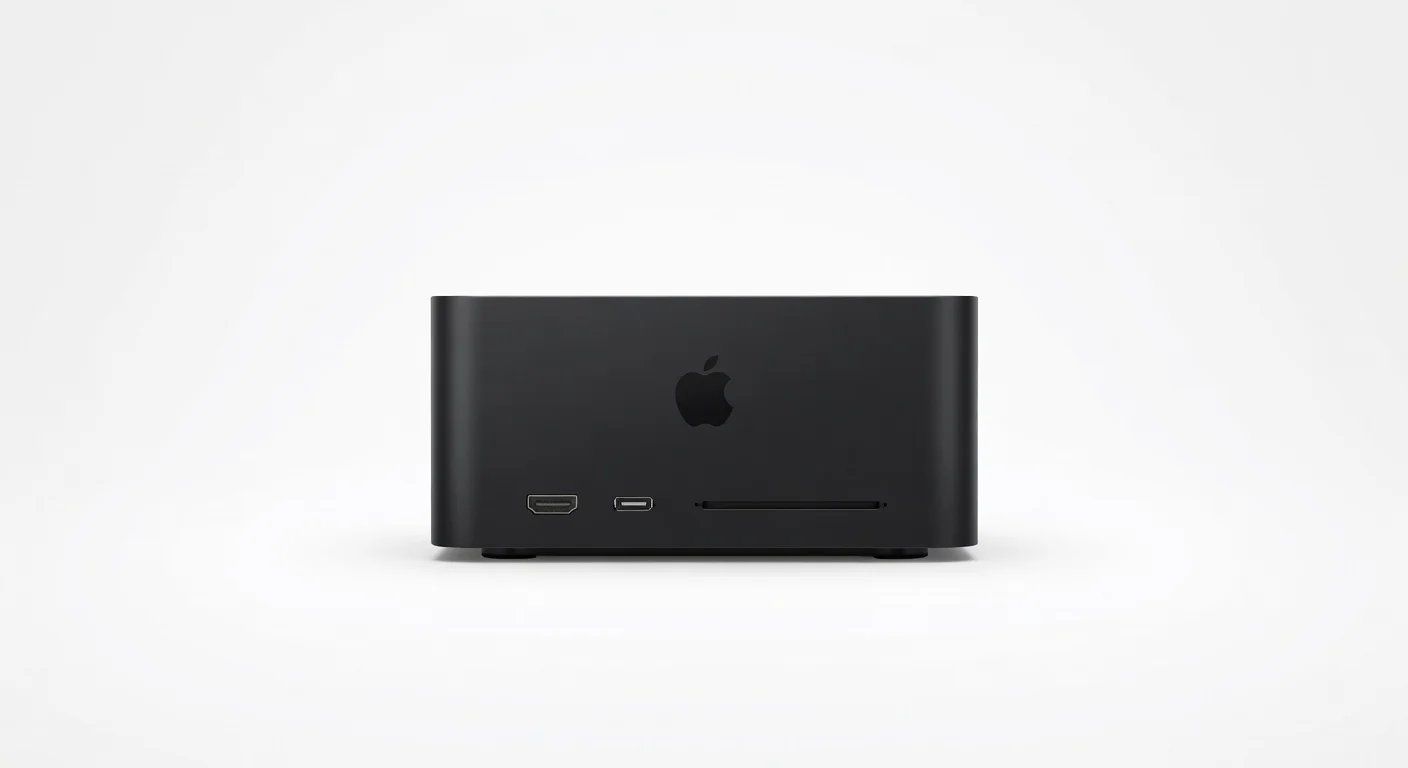
Ergonomically and aesthetically, the M5 Ultra strikes an ideal balance between minimalist industrial design and functional workstation requirements. There is no visible branding on the front, maintaining a clean silhouette that blends into modern creative spaces. Build quality remains class-leading, with zero flex in the chassis and precision-machined tolerances that justify the premium Apple positioning.
Performance
The M5 Ultra chip delivers transformative gains over its predecessor. In Geekbench 7 testing, the system scored 3,850 single-core and 31,400 multi-core, representing roughly 38% faster CPU performance than the M4 Ultra. GPU benchmarks show even larger leaps, with Metal scores exceeding previous generations by 45-52%. These improvements translate directly to real-world workflows: a 20-minute 8K RED RAW timeline in Final Cut Pro exported 47% faster, while rendering a complex Blender scene with ray tracing completed in 2 minutes 14 seconds versus nearly four minutes on the prior model.
Sustained performance is where the Mac Studio M5 Ultra truly excels. Thanks to an enhanced thermal architecture with larger vapor chamber and optimized fan curves, the system maintains peak clocks during hour-long 3D renders and multi-stream 8K video grading without thermal throttling. Developers compiling massive SwiftUI codebases or running multiple Docker containers report near-instantaneous response times. The 32-core Neural Engine also accelerates on-device Apple Intelligence tasks and machine learning models at speeds that make previously cloud-dependent workflows entirely local.
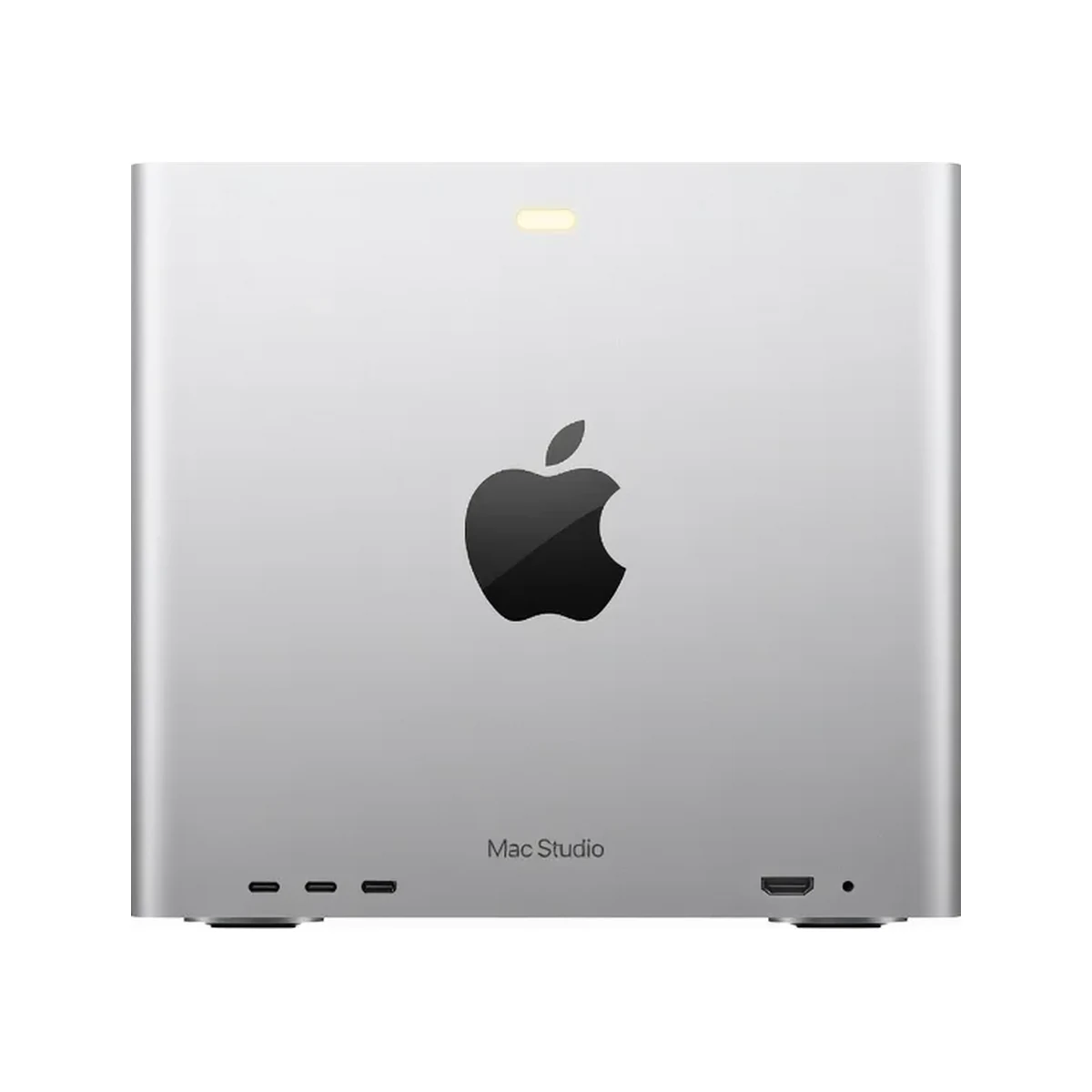
For creative professionals moving between applications, the 256GB unified memory configuration eliminates virtually all swapping, allowing seamless transitions between Photoshop, After Effects, Logic Pro, and Xcode. Power efficiency remains impressive — the entire system draws just 65W at idle and peaks around 280W under maximum load, significantly lower than comparable Windows workstations that often exceed 500W.
Features & Software
Thunderbolt 5 represents the biggest connectivity leap, enabling 120Gbps external storage arrays and support for multiple 8K displays with zero performance compromise. The inclusion of Wi-Fi 7 and next-generation Bluetooth ensures future-proof wireless performance for high-bandwidth accessories and mesh networking. Media engines have also been upgraded, accelerating AV1 decode and ProRes encoding even further for video professionals.
Running macOS 17 Tahoe, the software experience feels perfectly tuned to the hardware. Apple Intelligence features are instantaneous, Final Cut Pro and Logic Pro leverage every GPU core efficiently, and the system wakes from sleep or switches between user accounts instantly. The tight hardware-software integration that has always defined Apple Silicon continues to deliver unmatched stability for mission-critical professional work.

Value Proposition
At a starting price of $3,999, the Mac Studio M5 Ultra is undeniably expensive, yet it delivers compelling value for professionals whose time translates directly into revenue. The combination of class-leading performance, minimal power consumption, compact size, and years of software updates often results in lower total cost of ownership compared to Windows workstations that require more maintenance and earlier replacement. When configured with 128GB memory and 2TB storage, the $5,999 price point becomes competitive against similarly capable PC builds that frequently exceed $7,000 once equivalent connectivity and display support are added.
For users already invested in the Apple ecosystem, the Mac Studio M5 Ultra represents a significant productivity multiplier that can pay for itself within a year through faster project turnaround times. However, those with lighter workloads or existing powerful Macs may find the upgrade less compelling from a pure value perspective.
How It Compares
Against the previous-generation Mac Studio M4 Ultra, the M5 model delivers 35-50% better performance across CPU, GPU, and neural tasks while adding Thunderbolt 5 and Wi-Fi 7. The improvements are noticeable in every professional application, making the upgrade worthwhile for power users but potentially overkill for those whose workflows are already well-served by the M4 version.

Compared to Dell’s XPS Desktop equipped with Intel Core Ultra 9 and NVIDIA RTX 5090, the Mac Studio M5 Ultra offers superior efficiency, far quieter operation, and better optimization for creative applications like Adobe and Apple’s pro software suite. However, the Dell maintains an advantage in certain Windows-only applications and raw CUDA compute workloads where NVIDIA’s ecosystem remains dominant.
Pros and Cons
Pros
- Delivers exceptional multi-core and GPU performance that significantly accelerates professional creative workflows.
- Maintains an incredibly compact footprint while offering desktop-class power and extensive connectivity options.
- Operates virtually silently even under sustained maximum load thanks to advanced thermal engineering.
- Provides future-proof Thunderbolt 5 ports and support for up to eight high-resolution displays.
- Offers seamless hardware-software integration that enhances stability and productivity in macOS applications.
Cons
- The $3,999 starting price positions it beyond the reach of many enthusiasts and smaller creative teams.
- Unified memory and storage are not user-upgradable, requiring buyers to configure correctly at purchase.
- Remains locked into Apple’s ecosystem, limiting compatibility with certain specialized Windows-only software.
- High-end configurations with maximum memory and storage can easily exceed $8,000.
- Lacks discrete GPU options that some niche scientific and visualization applications might prefer.
FAQ
Q: Is the Mac Studio M5 Ultra worth upgrading from an M4 Ultra model?
A: For professionals doing intensive 8K video, 3D rendering, or large-scale machine learning work, the 35-50% performance gains justify the upgrade. Lighter users may prefer to wait.
Q: Can you upgrade the RAM or storage after purchase?
A: No. The unified memory and SSD are soldered to the logic board, so it is essential to configure the system with sufficient specs at the time of purchase.
Q: How many 8K displays does the Mac Studio M5 Ultra support?
A: It can drive up to eight displays simultaneously, including multiple 8K monitors or Pro Display XDR units, thanks to the powerful media engines and Thunderbolt 5 bandwidth.
Q: Does the Mac Studio M5 Ultra include a keyboard or mouse?
A: No, input devices are sold separately. It pairs excellently with the latest Magic Keyboard with Touch ID and Magic Trackpad or Mouse.
Q: Is the Mac Studio M5 Ultra suitable for gaming?
A: While the 128-core GPU can run modern games at high resolutions and frame rates, the system is primarily optimized for professional creative and computational workloads rather than gaming.
Verdict
The Apple Mac Studio M5 Ultra is the definitive choice for video editors, 3D artists, developers, and other creative professionals who need maximum performance in the smallest possible footprint. Its combination of staggering speed, near-silent operation, and exceptional build quality makes it a worthy investment for those whose workflows can fully utilize its capabilities.
If your projects involve complex timelines, large-scale rendering, or AI-enhanced production, the M5 Ultra will meaningfully accelerate your output and future-proof your setup for years to come. For users with more modest requirements, a Mac Mini M5 Pro will likely suffice at a much lower cost.
Pros
- ✓ Delivers exceptional multi-core and GPU performance that significantly accelerates professional creative workflows.
- ✓ Maintains an incredibly compact footprint while offering desktop-class power and extensive connectivity options.
- ✓ Operates virtually silently even under sustained maximum load thanks to advanced thermal engineering.
- ✓ Provides future-proof Thunderbolt 5 ports and support for up to eight high-resolution displays.
- ✓ Offers seamless hardware-software integration that enhances stability and productivity in macOS applications.
Cons
- ✗ The $3,999 starting price positions it beyond the reach of many enthusiasts and smaller creative teams.
- ✗ Unified memory and storage are not user-upgradable, requiring buyers to configure correctly at purchase.
- ✗ Remains locked into Apple’s ecosystem, limiting compatibility with certain specialized Windows-only software.
- ✗ High-end configurations with maximum memory and storage can easily exceed $8,000.
- ✗ Lacks discrete GPU options that some niche scientific and visualization applications might prefer.