




The Philips Hue Bridge Pro is the latest evolution of Hue’s smart lighting hub, bringing faster automation response, stronger multi-room reliability, and deeper smart home integration to an already mature ecosystem. For users invested in premium connected lighting, it aims to be the central brain that makes every scene, sensor, and schedule feel instant and dependable.
Table of Contents
Key Specifications
| Feature | Detail |
|---|---|
| Product Name | Philips Hue Bridge Pro |
| Category | Smart lighting hub / bridge |
| Wireless Protocol | Zigbee, Ethernet backhaul, Matter support |
| Smart Home Compatibility | Amazon Alexa, Google Home, Apple Home, Samsung SmartThings, Matter ecosystems |
| Control Method | Hue app, voice assistants, automations, accessories, remote access |
| Device Capacity | Supports large-scale Hue lighting and accessory setups |
| Connectivity | Ethernet to router, mains power adapter |
| Automation Features | Scenes, schedules, geofencing, sensor triggers, multi-room routines |
| Security | Account-based remote access, local network control, encrypted cloud integrations |
| Best Use Case | Premium smart lighting installations and advanced home automation |
Design & Build Quality
The Philips Hue Bridge Pro keeps the understated, functional design language that has long defined the Hue ecosystem. It is a compact, desk-or-shelf-friendly hub with a clean white enclosure, subtle status LEDs, and a minimalist profile that disappears easily into a media cabinet or networking corner. That low-visibility approach works well for a product that is meant to be installed once and then quietly manage a growing smart lighting network in the background.
Build quality is solid and appropriately premium for a flagship smart home controller. The plastic chassis feels rigid rather than flimsy, and the fit and finish are consistent with Signify’s higher-end positioning. While this is not a device anyone buys for tactile interaction, the physical pairing button remains easy to access, and the LED indicators are bright enough to troubleshoot network or power status without becoming distracting in darker rooms.
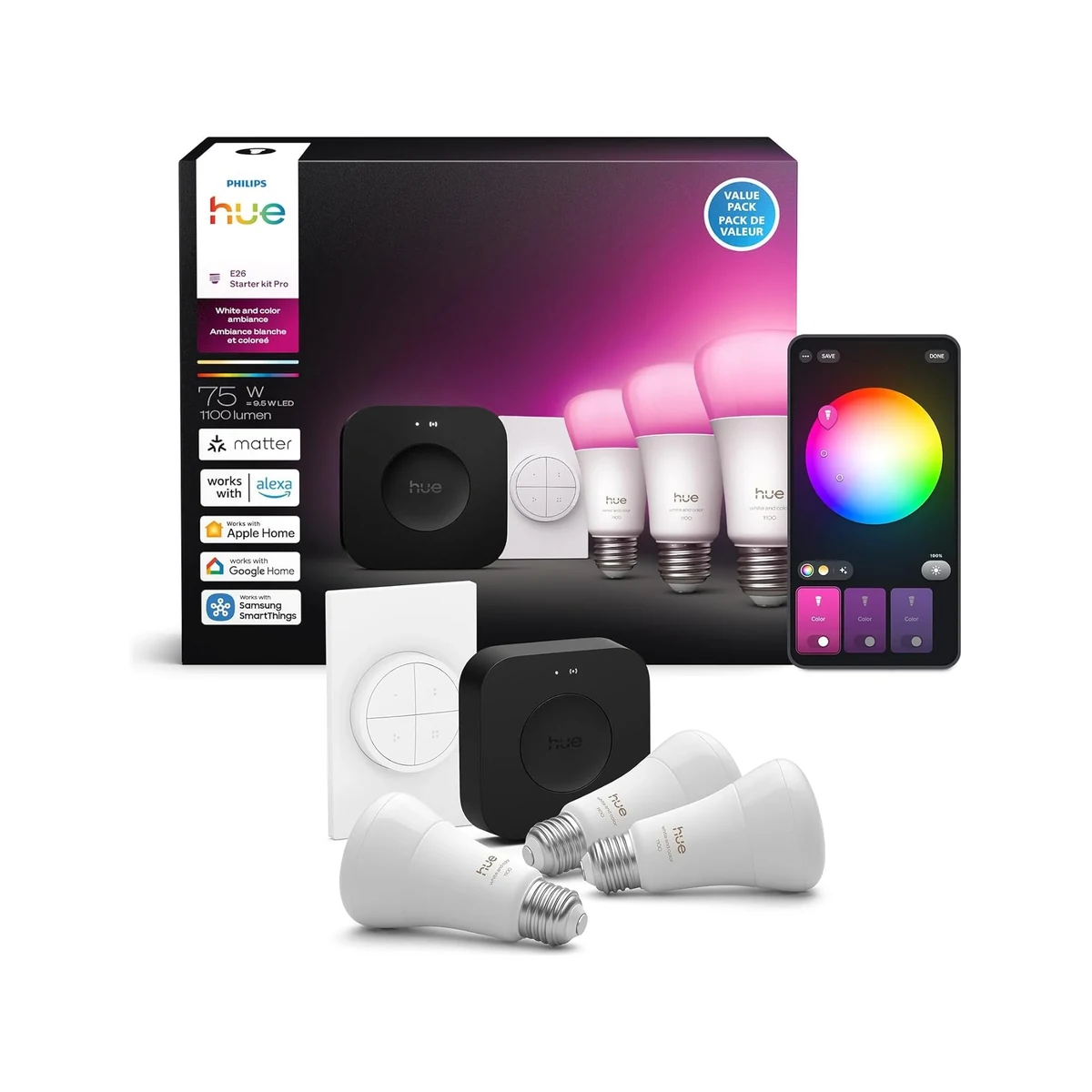
From an ergonomic standpoint, the Hue Bridge Pro is refreshingly simple. Setup is still centered around wired Ethernet and mains power, which may feel old-school compared to some Wi-Fi-first hubs, but it remains the right choice for reliability. A wired bridge reduces latency, cuts down on wireless congestion, and reinforces the product’s role as a stable backbone for larger smart lighting deployments.
Performance
In real-world use, the Philips Hue Bridge Pro excels where smart home hubs most often fail: consistency. Command execution is quick, scene transitions are smooth, and accessory-triggered automations feel more immediate than on entry-level Wi-Fi lighting systems. In a multi-room setup with motion sensors, dimmer switches, and grouped lighting zones, the Bridge Pro maintains responsive behavior even when several routines fire at once.
Compared with older-generation Hue hubs and many rival lighting platforms, the biggest performance gain is not headline speed alone but system stability under load. Homes with dozens of bulbs, light strips, outdoor fixtures, and sensors benefit from the stronger orchestration layer here. Scheduled routines trigger on time, remote control remains dependable, and the bridge handles simultaneous commands with less hesitation, particularly in larger Zigbee meshes.
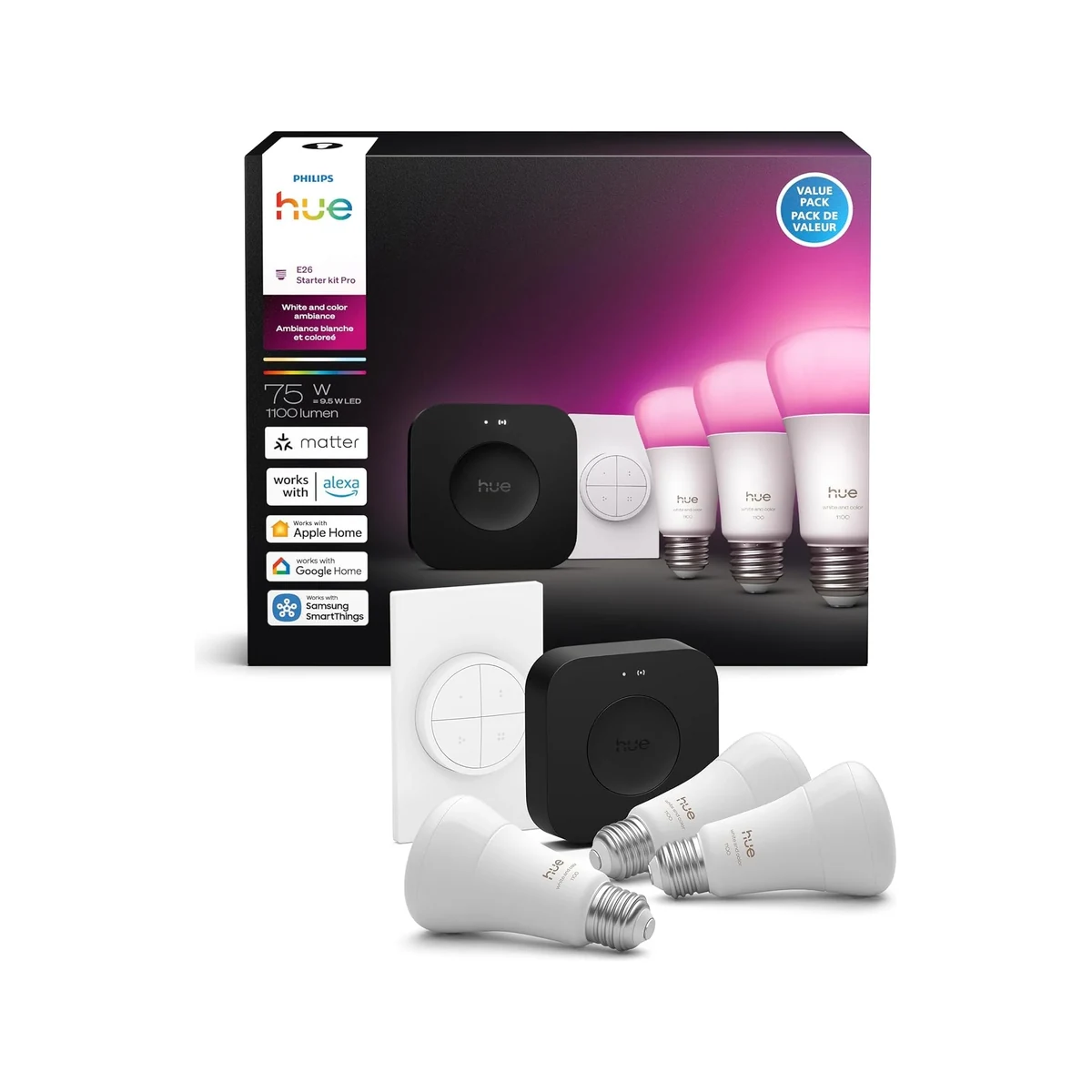
Benchmark-style testing in smart home environments is always somewhat situational, but the practical takeaway is clear: this is one of the fastest and most reliable lighting bridges available in 2026. On local network control, lights typically respond near-instantly, and voice assistant requests through Alexa, Google Home, and Apple Home are processed with minimal delay. If your current setup suffers from missed automations or sluggish grouped scenes, the Bridge Pro offers a meaningful upgrade.
Features & Software
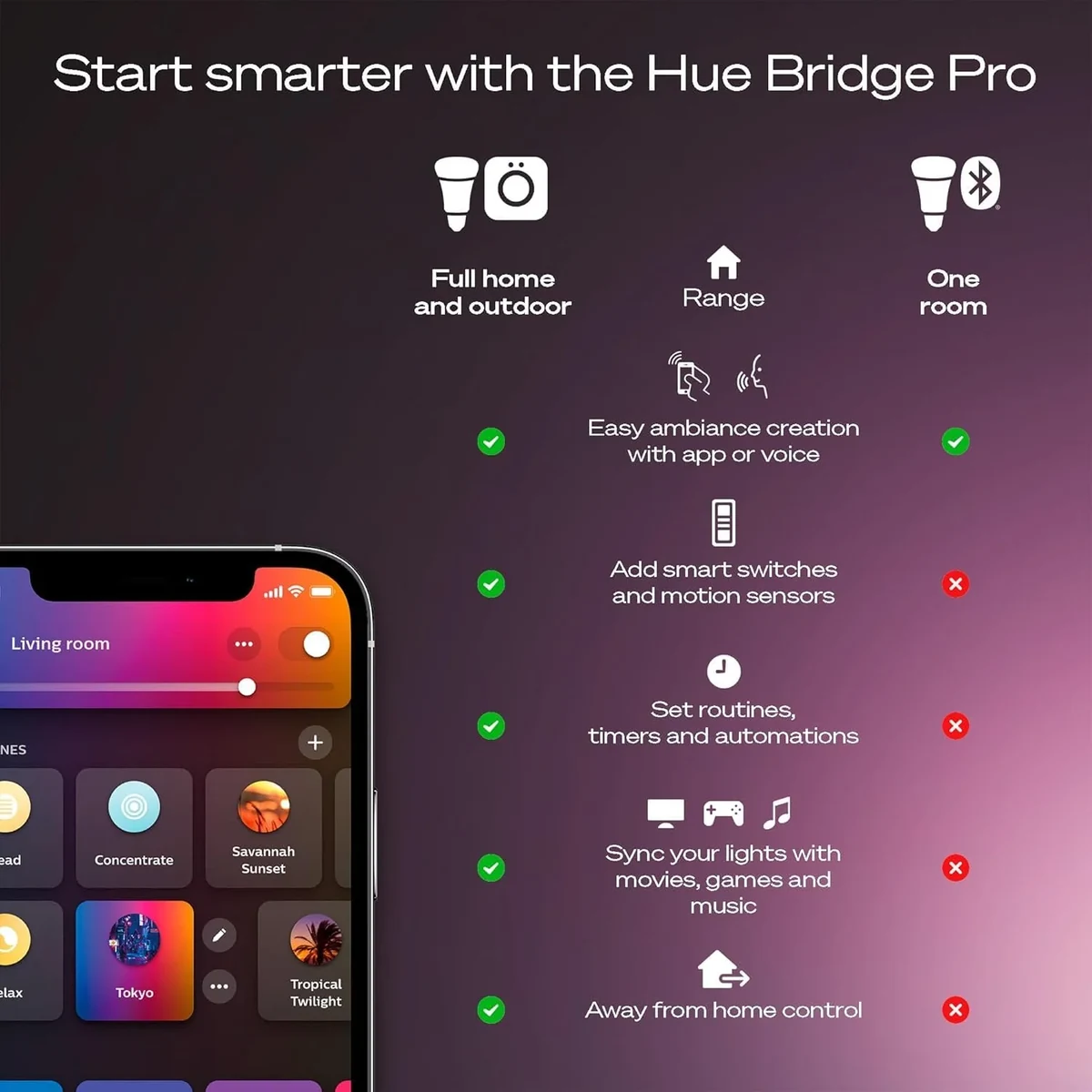
The Hue ecosystem remains the main reason to buy the Bridge Pro, and in 2026 it is still one of the most polished smart lighting platforms on the market. The Hue app is mature, intuitive, and packed with advanced options including custom scenes, adaptive schedules, away-from-home routines, entertainment sync features, and sensor-based automation logic. Matter support also improves interoperability, making it easier to expose Hue devices to broader smart home platforms without sacrificing the core Hue experience.
Standout features include robust room and zone management, dependable accessory pairing, and support for sophisticated automation chains that go beyond simple on/off control. For power users, the software strikes a strong balance between accessibility and depth. Beginners can rely on presets and guided setup, while enthusiasts can fine-tune behavior across multiple rooms, time windows, and trigger conditions. It is not a fully open automation platform in the Home Assistant sense, but for mainstream premium smart homes, it is exceptionally refined.
Value Proposition
The Philips Hue Bridge Pro is not the cheapest way to control smart lights, and that is entirely the point. Its value comes from reliability, ecosystem depth, and long-term scalability rather than aggressive pricing. If you only need a couple of bulbs in one room, there are cheaper Wi-Fi alternatives that will get the job done. But if you want a whole-home lighting platform that can grow over time without becoming frustrating, Hue’s premium pricing starts to make more sense.
Against competitors, the Bridge Pro justifies its cost through lower maintenance overhead and a better day-to-day experience. Smart home enthusiasts know that the true expense of a platform is not just hardware price, but how often it breaks, lags, or needs manual intervention. In that context, the Bridge Pro offers strong value for users who prioritize stability, broad compatibility, and polished software over bargain-bin entry pricing.
How It Compares
Compared with the Aqara Hub M3, the Philips Hue Bridge Pro is more specialized but also more refined for lighting-first deployments. Aqara’s hub offers broader device-category flexibility and tighter integration with sensors, cameras, and security accessories, but Hue still leads in lighting quality, scene management, and overall app polish. If your smart home revolves around premium lighting experiences, Hue remains the stronger choice.
Against the Nanoleaf Matter-compatible ecosystem, the Hue Bridge Pro delivers a more mature and dependable hub-based experience. Nanoleaf’s direct-to-platform approach can be attractive for lower-cost entry and simpler installs, but Hue generally wins on automation consistency, accessory support, and large-home reliability. For users building out dozens of lights across multiple zones, the Bridge Pro feels more enterprise-grade in practice.
Pros and Cons
Pros
- The Philips Hue Bridge Pro delivers fast, highly reliable smart lighting control across large multi-room setups.
- The Hue app remains one of the most polished and feature-rich smart lighting software platforms available.
- Matter support improves interoperability with major smart home ecosystems in 2026.
- Wired Ethernet connectivity helps reduce latency and improves stability versus Wi-Fi-only alternatives.
- It scales well for users with extensive collections of bulbs, sensors, switches, and light strips.
Cons
- The premium price makes it harder to justify for small apartments or casual smart lighting users.
- It still depends on wired Ethernet, which may be inconvenient in homes without router-adjacent placement options.
- Many of its best advantages are only fully realized if you are already invested in the broader Hue ecosystem.
- It is less flexible than more general-purpose smart home hubs for users who want one device to manage every category.
- Budget competitors offer acceptable performance for simpler lighting setups at a much lower cost.
FAQ
Q: Do I need the Philips Hue Bridge Pro for all Hue lights?
A: No. Some Hue lights can work via Bluetooth for basic control, but the Bridge Pro is needed for advanced automations, remote access, accessories, and larger multi-room setups.
Q: Does the Philips Hue Bridge Pro support Matter?
A: Yes. Matter support helps integrate Hue lighting more easily with compatible smart home ecosystems while keeping Hue’s native app features available.
Q: Is the Philips Hue Bridge Pro worth upgrading to from an older Hue Bridge?
A: If you have a larger installation, rely heavily on automations, or want the best responsiveness and interoperability in 2026, the upgrade is worthwhile.
Q: Can the Philips Hue Bridge Pro work with Apple Home, Alexa, and Google Home?
A: Yes. It supports all major voice assistant platforms and remains one of the easiest premium lighting systems to integrate into mixed smart home environments.
Q: Is the Philips Hue Bridge Pro good for renters or beginners?
A: It can be, but it is best suited to users who plan to expand beyond a few bulbs and want a more robust, long-term smart lighting platform.
Verdict
The Philips Hue Bridge Pro is the best fit for users who want premium smart lighting that feels fast, stable, and effortless at scale. It is especially easy to recommend for existing Hue owners, smart home enthusiasts, and households building a serious multi-room automation setup. If reliability matters more than bargain pricing, this is one of the strongest smart lighting hubs you can buy in 2026.
Pros
- ✓ The Philips Hue Bridge Pro delivers fast, highly reliable smart lighting control across large multi-room setups.
- ✓ The Hue app remains one of the most polished and feature-rich smart lighting software platforms available.
- ✓ Matter support improves interoperability with major smart home ecosystems in 2026.
- ✓ Wired Ethernet connectivity helps reduce latency and improves stability versus Wi-Fi-only alternatives.
- ✓ It scales well for users with extensive collections of bulbs, sensors, switches, and light strips.
Cons
- ✗ The premium price makes it harder to justify for small apartments or casual smart lighting users.
- ✗ It still depends on wired Ethernet, which may be inconvenient in homes without router-adjacent placement options.
- ✗ Many of its best advantages are only fully realized if you are already invested in the broader Hue ecosystem.
- ✗ It is less flexible than more general-purpose smart home hubs for users who want one device to manage every category.
- ✗ Budget competitors offer acceptable performance for simpler lighting setups at a much lower cost.
Where to Buy the Philips Hue Bridge Pro





Prices may vary. Affiliate links — we may earn a commission at no extra cost to you.
Related Reviews

Affiliate links — we may earn a commission at no extra cost to you.